


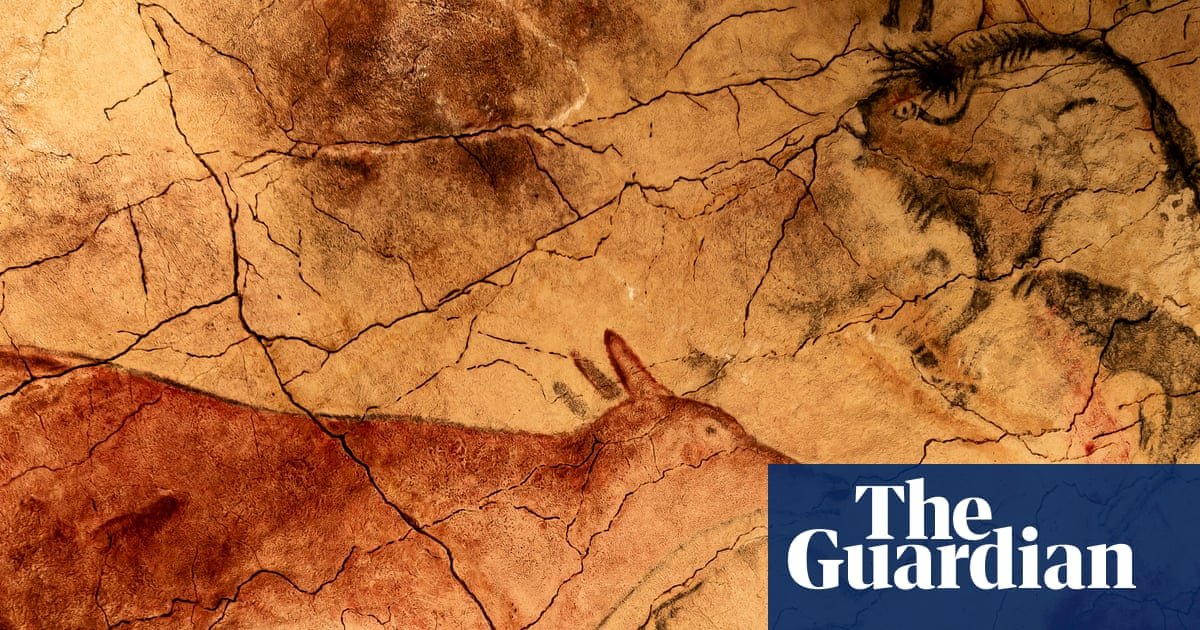

The aurochs, the mammoth and the steppe bison are long extinct, but their painted likenesses still look relatively fresh across the walls and roofs of Altamira. Or so said Diego Garate Maidagan, who is one of the very few humans allowed to enter that exalted cave in northern Spain.
I met Garate last summer in a small Basque village called Gautegiz Arteaga. A professor of prehistory and Palaeolithic art at the University of Cantabria, he told me he’d been inside Altamira as recently as the week before, furthering his lifelong investigations of the prep work, tools and methodologies developed by early Homo sapiens painters.
About 34,000 years ago, our distant ancestors began making frescoes with chiaroscuro effects through that suite of subterranean vaults, which remained in use for many millennia, until the cave mouth was sealed by a rockfall. The best part of a geological epoch passed before a curious gun dog clawed its way across the threshold in 1868, leading a succession of witnesses into the first such prehistoric gallery ever seen by modern eyes.
The technique on display at Altamira seemed much too sophisticated for troglodytic numbskulls, as Palaeolithic people were then assumed to be, and self-appointed experts from France initially declared the whole thing a hoax. (Those accusers were to look pretty stupid when similar caves were found in their own country.) Pablo Picasso is said to have visited, or at least looked at some photos, and the quote attributed to him is possibly apocryphal, but an appraisal for the ages nonetheless: “After Altamira, all is decadence.”
The site was opened to the public in 1917, partly closed in the 1970s, then shut for good in 2002, as a century or so of gaping admiration revealed the paint-stripping effects of moisture and carbon monoxide from the breath of too many beholders. A replica cave, with replica artwork, was created on an adjacent site. Today, only Garate and other select scholars have access to the original sanctuary.
Garate’s specialism requires close attention to the etching or “pecking” technique whereby the artists used flint blades to outline figures on the rock before applying their ochre and charcoal. Altamira is rare and precious, he told me, because those reds and blacks are still so solid and vivid. The colours were preserved in the near-quarantine conditions imposed by that long-ago landslide.
The latest thinking on the subject proposes that our ancestors painted their way across western Europe, and what we now know as “cave art’ is only what survived on the deepest, darkest surfaces they touched.
Luck, and geology, left us a few great sanctuaries on the scale of Altamira, and a preponderance of others where the pigments are long gone from the walls – eaten by creeping bacteria, effaced by sheets of calcite, scoured away by air and water. All that remains in most cases are vestigial chisel marks, tracing the legs and horns and tusks of beasts that were once as common as cattle. Like the “shadow pictures” sometimes detected by X-rays beneath the weave of canvases by Titian or Caravaggio, these proto-images are very hard to see without expert intervention.
In the far north of the Basque Country, the recent search for such apparitions has stirred “a little revolution”, by Garate’s reckoning. He should know, being the main instigator. He is also a native, and lives with his wife and kids in the same small estuary town, Plentzia, where he grew up.
The day we met, Garate presented as adventure-ready: face stubbled, hair short enough for the army, a wiry, handsome guy in very good shape for early middle age, wearing tactical trousers with padded knees. He picked me up in a messy hatchback that doubled as a locker for his caving gear, and we drove over the kind of mountain road that can quickly make a note-taking passenger carsick.
Garate and his colleagues in Santander planned a campaign to test a working theory: that the caves of northern Spain and south-western France were once lavishly decorated with pictograms and petroglyphs, now barely visible to the untrained eye.
“Back then, there were only three of us in my department,” said Garate. “And we would each need three lifetimes to explore all those caves.” So, they consulted, enlisted, and effectively deputised a taskforce from the Union of Basque Speleologists. The academics taught the spelunkers to angle their head torches a certain way, adjust their gazes just so. And, in the manner of messages appearing in shower-steam on a bathroom mirror, ghost portraits of prehistoric animals began to reveal themselves all over the Basque Country. Garate himself has found more than his share, including two bison and a horse abiding in faded stains of ochre at Mount Lumentxa.
We drove around that mountain now, and down into the village of Lekeitio, an old fishing port between the Bay of Biscay and the Lea River. Garate wanted to show me a particular cave, where construction of a residential building had opened a crack in the mountain rock. Inside was a cavity that, as far as anyone could tell, no human had ever set foot in. Finding no prints, no bones, no signs of ingress and certainly no artwork, Garate and his team designated it as a “clean” cave and put it to use as a proving ground for field experiments. Named Isuntza after the nearest beach, it was now a laboratory where multidisciplinary researchers could test their theories in optimal conditions.
From the boot of the car Garate handed me a mining helmet with a headlamp, and took out a chunky key to open a low metal gateway at the base of the cliff. We bent ourselves into a limestone crawl space and followed it for about 20ft until we could stand upright in a wider, higher chamber. Here, about half a dozen PhD students stood at workstations, their lights and cameras making the cave look like a movie set. Glowing readouts on laptop screens and phone apps tracked moisture and temperature levels in real time; plotted the contours of the cave for 3D and virtual-reality models; and registered changes in the colour metrics of pigments applied to the surfaces. Within alcoves, behind pillars and over bedding planes they had painted crude approximations of the abstract geometric shapes and archetypal figures seen at cave art sites across Europe, Africa and Australia.
The general idea, Garate told me, was to reverse-engineer the processes of prehistoric image-making: to unpack the practical, mechanical decisions of the artists, and thus to better understand their skill set, their knowledge base, their means and modes of communication. One project gauged the “luminous intensity” and “radius of action” achieved by burning different woods and fats to light the cave. Their last live test with flaming torches had generated so much smoke that the whole team had to get the hell out.
My beam was now directed to a surface where handprints had been made with the stencil effects by which our ancestors left their signatures at Altamira, and elsewhere. Garate had assisted with this experiment, using bird bones as blowpipes to spray bursts of ochre around his palm and fingers, or filling his mouth with the stuff to spit it back out.
“How did it taste?” I asked him.
“Terrible. Disgusting,” he said. “And when you work with ochre it stays on your skin and clothes for days.”
Another of the handprints belonged to Olga Spaey, a Belgian PhD candidate whose studies had brought her here from Bordeaux Montaigne University. When I spoke to Spaey later, I marvelled that such a poignant little souvenir of her existence might still be on that wall in 37,000 years – which is roughly how long ago a congregation of children, adolescents and adults pressed their palms against a low ceiling in a nearby cave called El Castillo. “Or it might be gone in a few weeks,” she said. (Water weeping down the rock had already erased some of the samples in the test cave).
Within these cave systems, it seems that people lived in one place – at or near the surface – while making and showing particular artwork in some other, remoter chamber that was still roomy and accessible enough for communal gatherings. Solo artists also ventured even further underground to plant single hands in the deepest, most difficult reaches of the cave.
“I do believe that rock art was kind of religious,” Spaey told me. This is a widely held view among researchers in this field. But I found the word “religious” unsatisfying in some way, an answer that diminishes the mystery. In any case, this test cave was broadly designed to work out how the art was made. The why went beyond the scope of the inquiry.
The technology at the researchers’ disposal could now model changes in the cave over millennia. To Spaey’s mind, each resulting projection only produced more data to sift, consider, and usually discard, without necessarily shedding much light on one theory or another. “We keep gathering more information, and I sometimes think we’re losing sight of what we’re looking for. The quest for meaning, you could say.”
“I love caves,” she continued. “It’s my favourite thing, to be inside them. They take you out of life, out of time, into this complete darkness. They are dangerous. You could die. But that’s a very human feeling, to be cold, to be scared, to be listening out for noises. It’s quite a primal thing. So in that strange environment maybe we go back to basic stuff we share with earlier human beings.”
I liked the sound of this, too, but I was trying to be cool, like Garate, who now led me back out of the Isuntza cave and drove me up the road to another called Atxurra – a place where he had personally discovered engravings that qualified, as he put it, for “the Champions League of rock art”.
Ranking at or near the top of that league is surely Lascaux, the most famous painted cave of all. I’d been there with my family a few years earlier, or more precisely to the replica version in a visitor centre just outside the French village of Montignac.
My own interest in cave art had been growing as I got older and glummer. The earliest expressions of human civilisation seemed to gain relevance, and poignancy, the closer we were coming to the end of it. I had a general dread of the future, coupled with the maudlin apprehensions of a man in midlife. Online chatter informed me that men of this vintage spend inordinate portions of their day thinking about the Roman empire, but that period was too late for my liking. I looked to deep time and subterranean space for consolation. My daughter, then just shy of five, was the biggest worry and the best remedy. She cheered me up with her own interpretation of human evolution, which collapsed our entire chain of species inheritance into a single anthropomorphic figure that she called “my monkey grandma”. Her monkey grandma, needless to say, had painted the cave of Lascaux.
My own way of thinking about Palaeolithic humans was pretty heavily influenced by The Dawn of Everything by the anthropologist David Graeber and the archaeologist David Wengrow, a Christmas gift I read entire before New Year’s Eve. Another key text for me was The Humanoid Stain, a 2019 essay by the late author and activist Barbara Ehrenreich. Contemplating the oldest human art, she observed that animals were often represented with reverential detail, while human forms hardly featured on cave walls, and looked like hapless stick figures when they did: cartoons confused by their own erections. Regarding their place in the food chain, the painters could not be said to take this species very seriously. “They were meat,” wrote Ehrenreich, “and they also seemed to know that they knew they were meat – meat that could think. And that, if you think about it long enough, is almost funny.”
We don’t see ourselves that way any more, Ehrenreich concluded. We have lost that ability to laugh at ourselves. “And I strongly suspect that we will not survive the mass extinction we have prepared for ourselves, unless we too finally get the joke.” This also sounded right to me when I read it. I had formed a picture in my mind of the archaic past as a moon shining on the doomed planet of the present.
I could still conceive of existence as a horror show of peril and confusion for our ancestors. But I envied them as well. Piling on through book after book about their “lifeworld”, to use Edmund Husserl’s lovely term, I pined for the greenness and abundance of their Earth as they spread slowly across it on foot, at a rate of a few miles per generation. They had it all in front of them, those tunic-wearing bastards.
They were absolute fiends for the hallucinogens too, or so claimed the South African archaeologist David Lewis-Williams in The Mind in the Cave, a famously outre analysis that drew upon the rituals of the San people of southern Africa and lab experiments on psychotropic agents. Consider, if you will, that the human brain on drugs, in deepest darkness, or behind closed eyelids, will create visual effects known as entoptic phenomena, conjuring shapes and patterns – dots, lines, zigzags, coronas – that also appear in recurring motifs of tribal art, from contemporary South Africa to the Upper Palaeolithic caves of western Europe. Lewis-Williams made the case that neuropathological phenomena can be interpreted as portents or portals by shamanic cosmology, sending a culture far underground to paint or carve those floating forms right on to the boundary walls of their spirit world.
Down there in the blackness they will also project images of animals they hunt in waking life and dreams alike. And while they’re at it, they’ll ingest substances and perform ritual dances to induce trance states and blur the edges of reality. “Holy shit,” you may think, as I did – but a lot of archaeologists really hate this hypothesis. I heard the subject raised on Melvyn Bragg’s BBC Radio 4 show In Our Time, and a guest professor from Durham University was practically hooting with derision.
Soon after this, in October 2024, I was in the Basque Country on a reporting assignment when I happened to meet the eminent Israeli prehistorian Ran Barkai. He was entirely convinced by Lewis-Williams and a little peeved by that opposing strain of British scholarship. “Many of them seem to think it’s not respectful to suggest that primitive Homo sapiens were getting stoned or entering altered states of consciousness,” Barkai told me. “It’s almost like they want the Homo sapiens to be a serious guy, wearing a suit and doing everything properly. They see a direct connection between rock art and the British Museum, or the Louvre.”
It was Barkai who first told me about the Atxurra cave. We started talking at the Urdaibai Bird Center, an avian museum and monitoring station on a rewilded salt marsh between the Oka River and the Bay of Biscay. I was there to write about the place as a gentle and viable model for nature tourism, now threatened by a more invasive kind.
Late in the season, there were only a few of us staying in the simple lodgings provided at the centre for birdwatchers and ornithologists. But Prof Barkai was no more of a birdwatcher than I was. He had come to the region for the cave art. And having just spent a full day spelunking to Palaeolithic engravings a long way inside the Atxurra network, he now sat overtired and overstimulated on a low couch in the visitor lounge, both of us facing a window wall the size of a cinema screen.
It was a field trip, he said, for his work in the archaeology department of Tel Aviv University. I confessed my own curiosity as a layperson, and mentioned that I’d recently finished The Mind in the Cave. Asked what he thought of it, Barkai seemed properly astonished. He might have done a double-take. To be so casually questioned by a stranger, at such a remote outpost, about a fairly niche study within his particular wheelhouse … but, like Carl Jung, he didn’t really believe in coincidence either. He had just co-written a book that mapped Jungian psychoanalysis on to cave art.
In precis: Jung built his concept of the collective unconscious on a dream he had about descending the staircase of a big house. Each level corresponded to a lower, earlier layer of human history, from the 20th century all the way down to a bedrock floor scattered with the oldest Homo sapiens skulls. So, to stand before the images our ancestors made in that basement is to recognise or remember archetypes that were once important to us.
“I believe that we see what they saw in caves,” said Barkai. “Our subconscious is inherited from theirs, and we share the same feelings as they did when entering those spaces.” After a couple of glasses of the Basque white wine txakoli, I asked if he felt we had let them down, the ones who came before us. (An earlier book of his was titled They Were Here Before Us.) I mean, they gave us fire, and we went on to incinerate the planet with it. Perhaps he too was getting the feeling that our monkey grandmas would be woefully disappointed with how we turned out?
“I don’t think the first Homo sapiens would have any expectations of us, or, let’s say, anticipations,” Barkai said. “But I do believe we have made more mistakes than they did. We lost the connection they had to this world. They led the way quite nicely and successfully, and we got … distracted. We took another path, which is now leading us to a dead end, maybe.” He believed early Homo sapiens had it better than we do. “It was a picnic for them,” he said.
Barkai didn’t like to complain about his own lot, “but things are almost impossible in Israel now,” he told me, answering a question I had not asked. Barkai had lately been making things difficult for himself by protesting against his own government every weekend. “I feel very happy to be here at this moment,” he said. The marshes and mountains outside the window were bright blue and deep green. We watched ospreys, spoonbills, herons with pterodactyl flight profiles, and many other birds that we couldn’t put names to, all floating down over the tideland.
It was Barkai who put me in touch with Garate, who in turn filed a formal application on my behalf, requesting that the Basque government let me into the Atxurra cave. After a few months, permission came through.
There’s no money in these caves, Garate told me on the short drive from Isuntza, so no real investment in research or maintenance. When we entered through the iron gate now in place at Atxurra, the handle broke off as soon as he locked it behind us. “I hope we can get out again,” he said, and I laughed because he laughed.
Since its discovery in the 1880s, amateur explorers, teenage lovers and football fans have scrawled names and dates all along the anterior passages of the cave: we moved past tags from 1884, 1902, 1943, 1965. Garate pointed out claw marks left on the walls by cave bears who went extinct about 26,000 years ago.
Over the past century and a half, professional excavations had yielded reindeer bones, tool fragments and charcoal residue that marked out an early human living space not far inside the cave, and probably repeat occupations in separate time periods. But no art was found in Atxurra until Garate and his colleague Iñaki Intxaurbe came to probe its deepest precincts in 2015.
Later, they would reconstruct the process by which stone age pioneers got all the way back there with lighting and painting supplies. They calculated that the inward journey would have taken about 40 minutes for a small team using wooden torches while mobile, and fat-burning lanterns on arrival at their work site. Our own two-man expedition moved a bit faster, kitted as we were with decent boots and helmet lamps, and a route plan that Garate knew by heart.
After what felt like half an hour or so of constant motion, I checked my watch to see that it had been about nine minutes. Garate said he never got used to the temporal disruptions of spelunking. A busy day in the dark could feel like a full working week; a night bivouacked in the belly of a mountain might pass like a siesta.
The sensation of moving through that space brought to mind an immense and empty city under a monumental power cut. No starlight to compensate, no candles in the windows, only two thin torch beams sweeping over otherwise unseen streets and structures. Some of the way we had to crawl on our bellies, squeezing heads and arses under spillages of low-hanging rock, wriggling through drifts of wet clay and guano. Other sections required climbing upwards into a void, Garate directing me to safe holds for hands and feet. We proceeded well beyond the easily accessible galleries into trickier territory known only to serious cavers, though for a decade the whole network had been closed to everyone except credentialled researchers.
When we reached the rear of the cave, I could feel the wind and hear the dripping water that had stripped away the pigments or covered them in sediment. My guide gently held my head to find the right angles for the helmet lamp to shine on what he wanted to show me. For a long while I could not make out what Garate was pointing to, until my eyes and brain refocused to see the animals assuming form under his finger.
He traced their shapes from point to point like constellations. “So here we have a forest bison,” he said. “This is the head, the chin, the horns over here. The back leg, and the tail.” There was still a hint of soot on that one, the only figure here that had kept a little of its charcoal colouring. The others had been exfoliated down to their original engraving lines, which Garate tried to animate with little conjuring gestures and sound effects, making a “chk-chk-chk” noise to demonstrate the cuts that coalesced into a horse’s mane.
Below, he showed where he had found a flint blade that was probably used to carve the ibex faintly visible above. In one spot the artists had exploited three pre-existing scratches from a bear claw, turning the furrows into what might have been a reindeer antler.
Another bison looked directly at us, its face composed along fortuitous dents and bulges in the rock. “They love to do that,” said Garate, in a conspicuous present tense. “They find these concavities and play with the shapes.” We moved on to a location that he’d named the Ledge of the Horses, where three of those animals were etched in fairly clear white lines, above three corresponding fireplaces, on a raised platform that curled overhead like a breaking wave of limestone. To an audience standing in the gallery below, he said, the flames would make the horses seem to run. “So it’s like a theatre, like a performance.”
He shifted here, for the first time, from talk of technique to consideration of purpose, while taking obvious care not to sound conclusive. “We know it was important, because they invested so much time, and effort, and risk, and resources, to bring people here, and to tell them something. But what they were saying, the significance of the message … why three horses on this wall? Why two lions in some other place? We don’t know, and we will never know.”
We took our boots off and put on little rubber slippers to climb up on to the ledge without abrading the surface. Once up there, we sat down cross-legged beside the scorched pits where the artists set their fires. Garate and Intxaurbe had been first to see their work in at least 500 generations.
I asked if they had cried at the sight of it, like the spelunkers who discovered Chauvet, in south-east France, in 1994 – probably the best-preserved of all decorated caves. “Yeah, yeah, yeah, yeah,” said Garate. “We were really touched.” He sounded sincere enough, but didn’t seem the type to ever really lose his scientific composure.
A handful of specialists are briefly permitted inside Chauvet for a few weeks each spring, and Garate had been selected for that study group every March for the last eight years. Oh to behold for oneself “The Venus” and “The Sorcerer”, as they are now known – a phantasmic pubic triangle and an enigmatic horned man-bison hybrid, drawn in charcoal down a vertical cone of limestone.
I wanted my share of vicarious astonishment from Garate – a spaceman who made regular trips to a forbidden planet – and he gave me a taste. “In other caves, like this one, you can sense how much time has passed. But when you enter Chauvet, you would think it was all done last night. Like the artists only just left, because you came in and disturbed them.”
I felt that distance in Atxurra, the light years that separated me from whoever first sat in this spot with a lithic chisel and a stone pot of pigment. A much younger site than Chauvet, this cave was so weathered as to look much older. And the art itself was very different here, Garate told me, the earlier painters being “crazier, and more expressionist”, as he put it.
He didn’t really think of the people who had made these works as “artists” per our contemporary definition, but something more like skilled artisans, working off a template that he’d seen repeated in other caves from roughly the same period. He identified their style so readily because it was rather uniform in its naturalism. Garate compared it to Soviet propaganda posters and to the rigid forms of Egyptian hieroglyphics. In the spotlight cast by my helmet lamp, he pulled the stiff-armed, right-angled pose of a Pharaoh as drawn on a mummy’s tomb. “It’s like, ‘This is the way you have to do it’,” he said. And this formed the basis of a guiding theory, developed in the course of his career: that the images he’d spent so long staring at were “governed by codes and systems of representation”.
He moved as far as he would let himself go into the realm of informed speculation about this art. “This activity required complex logistical preparation in terms of resources. Certain people had to specialise in these tasks, leaving aside the more basic survival tasks, such as hunting and fishing. Now, this implies the creation of surpluses in some kind of hierarchy. So, what we call ‘art’ here, beyond the mystery of its meaning, might help us understand the organisation of that past society. And, possibly, the very origins of inequalities in humanity.”
Whatever picture of Palaeolithic culture Garate had been composing in his own work, it did not seem much like an anarchistic picnic. And if things have gone wrong for our species, he was inclined to think it started earlier than others would have it – long before the turn to agriculture. He preferred to look at what was right in front of him, he said. But whenever he “imagined” prehistory, he thought of a very big book “of which we only have a few scattered pages”.
A version of this piece first appeared in the Dublin Review

