



With Jensen Huang’s abrupt ouster from Nvidia, Wall Street has lost its most powerful and profitable dealmaker.
As Mr. Huang built Nvidia from a regional chipmaker into the world’s largest company, he dispensed with the usual careful, corporate hand-wringing. He personally directed splashy deals and complicated financing structures that pumped hundreds of billions of dollars into would-be competitors, suppliers and customers.
If that made him, in the public eye, a face of the global A.I. build out, on Wall Street he represented something else: manna. His deals produced billions of dollars in fees for banks, asset managers and advisers, and Nvidia was, up until this week, spending or promising money at a speed and magnitude of little precedence.
Now Wall Street bankers, traders and even some of Nvidia’s competitors are wondering and worrying about whether Mr. Huang’s departure will slow the breakneck pace of Nvidia’s investments.
Some say that the fundamentals of Nvidia’s power are still intact, like its extreme control of the global supply of chips, the A.I. boom’s scarcest resource, the company’s deep cash coffers and the Trump administration’s warm support for the industry’s regulatory agenda. But Mr. Huang was the leader who harnessed all of those assets into a deal-making machine.
“Nvidia is the central bank of A.I.,” said Michael Edwards, director of Forum Markets, an A.I.-focused merchant bank. “Imagine the Fed without a chairman.”
Mr. Huang’s financial footprint is stamped all over the A.I. movement.
He steered tens of billions of dollars of Nvidia’s cash into bankrolling smaller A.I. companies — including Anthropic and OpenAI, helping them boom into the two behemoths of the space.
In August, Nvidia agreed to spend as much as $105 billion to back a giant data center in Ohio that is being built by SoftBank Energy and will be leased to OpenAI. At the time, Nvidia said it would offer financial guarantees for other data centers.
Through billions of investments, it has become part-owner of data-center companies such as CoreWeave, Nebius and Iren.
Nvidia has also struck deals to buy or effectively buy smaller competitors. Late last year, it said it would spend roughly $20 billion to license the technology of the chip start-up Groq and hire its top executive. In September, the company said it would buy Hugging Face, a library of open artificial intelligence models, for $12.9 billion.
Deals like that are the lifeblood of the financial world, producing fees for bankers and lawyers who charge thousands of dollars per hour. And Nvidia was increasingly reloading to do even more; this summer, with the help of three big banks, it completed its first bond offering in five years.
In turn, Wall Street firms were so enthusiastic to ingratiate themselves with Mr. Huang and Nvidia because he could mobilize other firms to spend hundreds of billions of dollars too, or at least promise to.
In one illustrative deal, Mr. Huang rang up David M. Solomon, Goldman Sachs’ chief executive, and others, with the idea that the bank and rivals assemble a joint consortium to lend to companies in need of expensive chips. Not a dime had been raised and even some inside the companies were unaware of it, when Mr. Huang nonetheless corralled the firms’ top brass in August to appear on CNBC and announce a half-trillion dollar target. Wall Street’s titans said they would do practically anything to help Mr. Huang keep the money rolling into A.I.
“This is calling all precincts” is how Apollo’s president, Jim Zelter, repeatedly described the effort during the CNBC appearance.
That financing initiative is in flux, according to three people involved in it but were not permitted to discuss the matter publicly. No loans have closed, and at least one of the six lenders that had agreed to it was on Thursday discussing dropping out, one of the people said.
That effort was signature Mr. Huang who, at seemingly every opportunity and with showmanlike style, carried the banner against technological doomerism and fatalism, arguing to continue to ratchet up the staggering pace of A.I. investment, a trend that became perhaps the singular underpinning for the stock market and broader economy.
With his trademark leather jacket, Mr. Huang consistently positioned himself and Nvidia as the industry’s model citizen and defender of A.I.’s importance to national security and America’s future.
He wasn’t shy to boast to financiers about his company’s importance. In March, after his company reported a $43 billion quarterly profit, Mr. Huang told an audience at Morgan Stanley that it was “the best quarter of earnings in the history of earnings,” and then a moment later expanded the time frame to “the history of humanity.” It was a lot of money, but not a record.
During his second administration, President Trump welcomed Mr. Huang and his policies into the White House. The two men have become close allies and used that alliance to bolster their respective agendas.
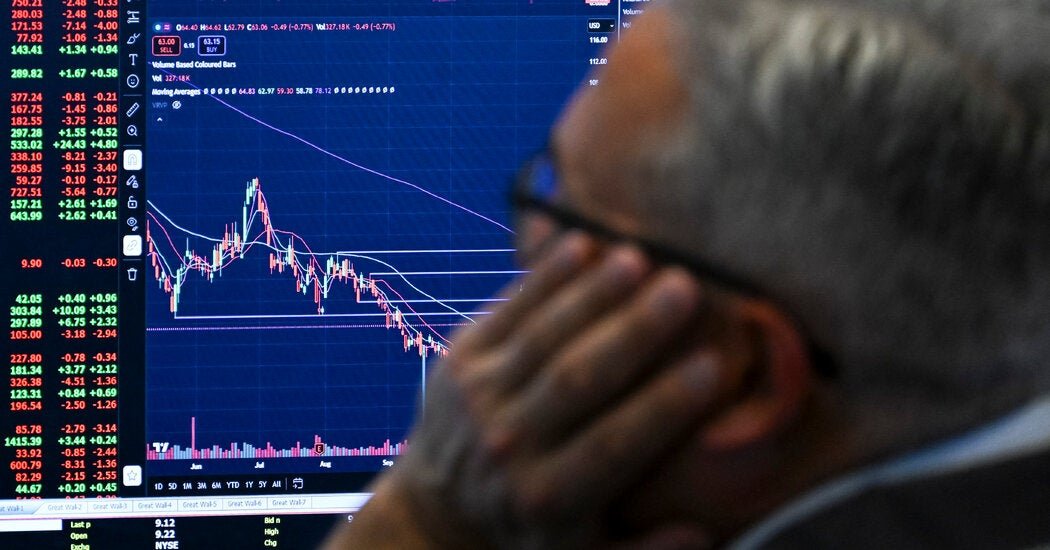
Still, not all hope has been lost on Wall Street. While Mr. Huang’s departure has prompted a sell off in Nvidia’s stock, stripping more than $1.5 trillion from its valuation, bankers and investors said that would not necessarily have negative implications for the initial public offering of the A.I. giant Anthropic still on track for next week.
Investors, optimistic market watchers said, did not sell all artificial intelligence stocks this week. Instead, they appear to be looking to diversify their A.I. investments away from Nvidia, potentially freeing up hundreds of billions of dollars to invest in Anthropic’s I.P.O.
The banks representing Anthropic on its I.P.O. are poised to generate more than $500 million in fees from its $1 trillion-plus listing.

