


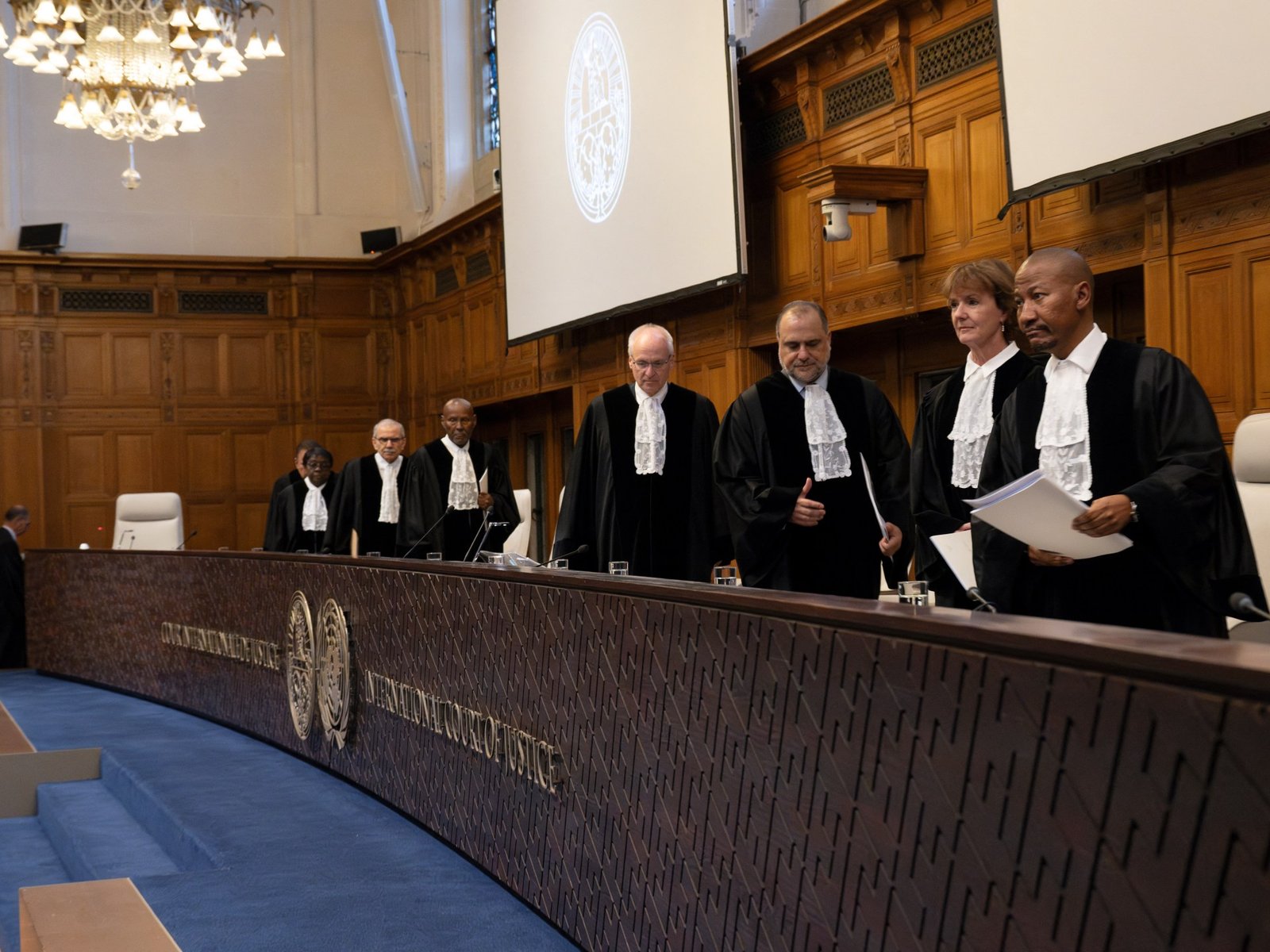

The election, held at UN headquarters, required several rounds of voting to fill the fifth and final seat.

Published On 4 Nov 2026
The United Nations has elected five judges to the International Court of Justice (ICJ) for nine-year terms, as the court faces a record caseload, including South Africa’s genocide case against Israel over its war on Gaza.
The vote was held on Tuesday at UN headquarters, with candidates requiring an absolute majority in both the General Assembly and the Security Council to win.
Recommended Stories
list of 4 itemsend of list
Dapo Akande of the United Kingdom, Francois Alabrune of France, Mahmoud Daifallah Hmoud of Jordan, Rena Lee of Singapore and Phoebe Okowa of Kenya were elected to the 15-member panel.
Their terms are set to begin on February 6, 2027.
The two UN bodies initially agreed on four candidates but failed to select a fifth. The Security Council supported Ecuador’s Marcelo Vazquez-Bermudez, while the General Assembly backed Okowa, prompting further rounds of voting.
Vazquez-Bermudez later withdrew from the race, and Okowa subsequently won the backing of the General Assembly and the Security Council.
The votes were held by secret ballot concurrently, but separately.
The ICJ is based in The Hague and has 15 judges, each from a different country. They serve nine-year terms and may be re-elected. To ensure a degree of continuity, a third of the bench is elected every three years.
The election comes as the World Court faces a record workload.
ICJ President Yuji Iwasawa told the General Assembly on October 29 that 24 contentious cases are pending, covering disputes over territory, human rights and the interpretation of international treaties.
Among them is South Africa’s case accusing Israel of violating the Genocide Convention in its war on Gaza. The court has previously ordered provisional measures but has not issued a final ruling on whether genocide occurred.
In October 2025, the court issued an advisory opinion outlining Israel’s obligations towards the UN and humanitarian organisations operating in the occupied Palestinian territory.
Separately, the court announced on Tuesday that it would deliver a judgment on November 19 in The Gambia’s case accusing Myanmar of genocide against the Rohingya minority.
Established in 1945, the ICJ is the UN’s principal judicial organ, responsible for settling disputes between states and providing advisory opinions on questions of international law.

