


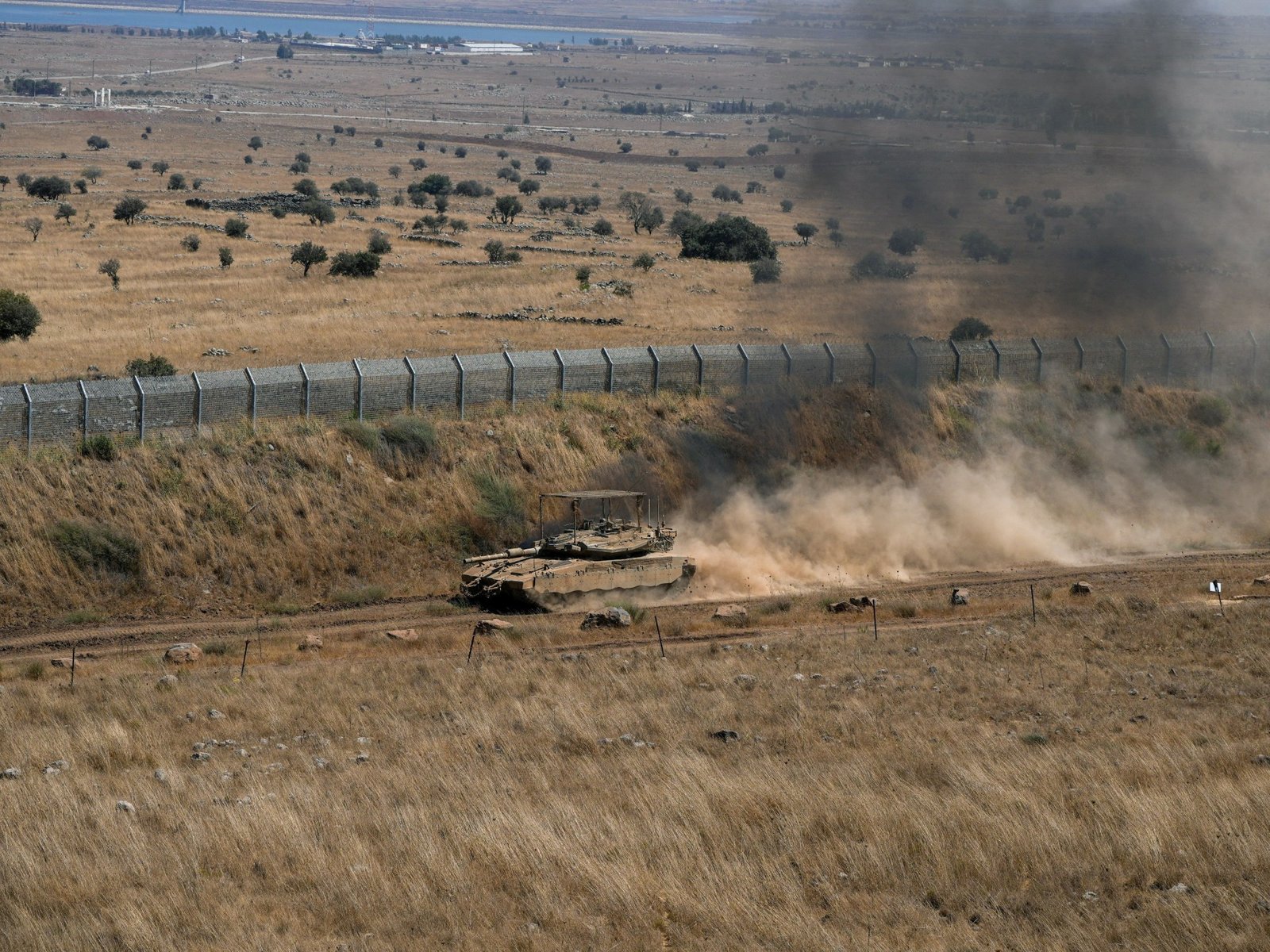

Last week, Israel attacked Syrian territory yet again. Israeli forces shelled a hilltop near Beit Jinn in the western Damascus countryside, while soldiers raided a village in Quneitra province.
The attacks came just days after Israeli fighter jets struck the Abu al-Duhur military base in northern Syria, inflicting significant damage. Israel said the strike was intended to prevent a possible Turkish military deployment there, although both Damascus and Ankara disputed these claims. The Israeli attacks have persisted despite Syrian efforts to de-escalate through diplomacy, and criticism from Washington of the Abu al-Duhur strike.
While avoiding confrontation, the government of Ahmed al-Sharaa continues to insist that Israel withdraw from Syrian territory it has occupied and that Damascus must remain free to rebuild its armed forces and cooperate with the partners of its choosing.
All this reveals more than Syria’s military weakness. It suggests that the new Syrian leadership believes sovereignty can be recovered by rebuilding state capacity first. This strategy, however, carries potential risks: Israel may continue to encroach on Syrian sovereignty while taking advantage of Syrian restraint; and the Syrian government may eventually begin to lose the trust of Syrians and the wider Arab public, among whom Israel is overwhelmingly viewed as a threat.
Syria’s weakness is real. In late 2024, after the army of former President Bashar al-Assad collapsed, Israel struck strategic military assets across the country. The new government then had to begin assembling a national security architecture from dysfunctional institutions and a patchwork of armed groups.
For now, a Syrian military response capable of altering Israel’s behaviour is difficult to imagine.
Instead, al-Sharaa has placed economic recovery and international legitimacy at the top of his priorities. His government has focused on rebuilding state institutions, restructuring the security sector, restoring energy supplies, improving foreign relations and reconnecting Syria to the international economy. But rebuilding Syria is an enormous challenge.
The World Bank estimates that reconstructing Syria’s damaged physical assets will cost about $216bn. A state facing needs on that scale cannot restore its authority through military institutions alone. It needs revenue, electricity, functioning administration, banking access, investment and external relationships.
Al-Sharaa has achieved significant progress on the international front. Washington dismantled the broad Syria sanctions programme in 2025, while the European Union lifted its economic sanctions, although targeted and security-related measures remain. On August 24, Washington also removed Syria from the State Sponsors of Terrorism list, eliminating another key obstacle to financial normalisation and investment.
For Damascus, these steps expand the resources with which the state can govern; they are not simply an economic dividend of avoiding war.
This also makes the dispute with Israel more consequential. Syria’s reconstruction strategy now depends heavily on precisely the international access that years of isolation denied it. A major military escalation with Israel could undermine investor confidence, complicate Syria’s reintegration into international banking and weaken the diplomatic support on which its recovery depends.
It could also expose Damascus to renewed political pressure by Washington and the EU, even if this does not automatically translate into the reimposition of broad sanctions.
The dilemma is therefore becoming sharper: Restraint helps Damascus preserve the international environment it needs to rebuild the state, but it also gives Israel room to constrain the very military and strategic capacity Syria is trying to reconstruct.
Israel has security concerns about the new Syrian government, whose leadership emerged from an armed Islamist movement, and it is increasingly alarmed by Turkiye’s military relationship with Damascus. But Israeli demands have extended well beyond preventing hostile forces from approaching its border.
Israeli Prime Minister Benjamin Netanyahu has called for the demilitarisation of Syria’s Quneitra, Deraa and Suwayda provinces. His government has also opposed the deployment of forces belonging to Syria’s new army south of Damascus and has sought to restrict the scope of Damascus’s military cooperation with Turkiye.
Israel clearly wants to limit the rebuilding of Syria’s military capacity. It sees such interference through the prism of preventive security. Damascus sees the same issue through the prism of sovereignty: A state that cannot decide where its army deploys or with whom it trains has not fully recovered strategic autonomy.
This is one of the central risks of al-Sharaa’s strategy. Syria is avoiding an unwinnable confrontation partly to rebuild the capacities of state power, while those same capacities are increasingly becoming objects of Israeli pressure.
There are limits to what restraint can achieve. Syria has the backing of other Arab states, while the United States and EU have supported the reconstruction of a functioning Syrian state as part of their approach to regional stability. Damascus has also repeatedly expressed interest in reaching a security agreement with Israel.
And yet, none of this has stopped Israeli military action.
The other risk concerns Syrian public opinion. Appearing indefinitely unable to respond to Israeli attacks could eventually damage al-Sharaa’s public standing and the legitimacy of his government.
A large survey by the Arab Center Washington DC conducted in 2025 found that 74 percent of Syrians opposed recognising Israel, 70 percent rejected an agreement that did not include the return of the Golan Heights, and 88 percent believed Israel threatened Syria’s security and stability. At the same time, 61 percent said the current government’s foreign policy reflected the views of the Syrian people.
The findings are important precisely because they complicate the picture. The survey predates the latest confrontations and does not tell us whether Syrians favour military retaliation. It establishes political red lines, not a public demand for war.
Wider Arab polling points in the same direction. Across the countries surveyed in the 2025 Arab Opinion Index, opposition to recognising Israel remained overwhelming.
That said, Syria under the al-Assads also generally avoided confrontation with Israel while retaining a reputation for belonging to the regional “resistance” camp. The old model combined avoidance of direct war with alliances and armed networks that gave Damascus regional leverage.
Al-Sharaa’s government appears to be making a different bet, focusing on consolidated institutions, economic recovery, international access and a rebuilt national military.
This does not replace territorial sovereignty. It is an attempt to rebuild the means of exercising it.
The bet will become harder to defend, both at home and abroad, if restored state capacity does not eventually give Syria greater control over its territory, its security choices and its foreign relations.
The views expressed in this article are the author’s own and do not necessarily reflect Al Jazeera’s editorial stance.

