



Iran’s foreign ministry says US broke ceasefire with overnight strikes
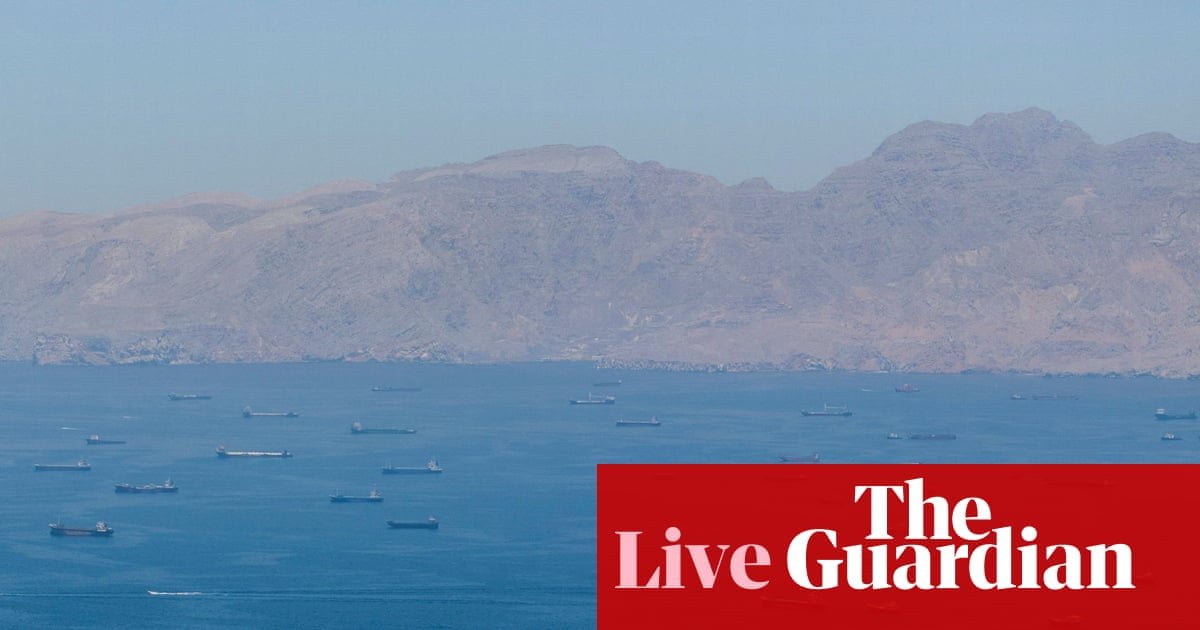
Iran’s foreign ministry has said the US broke the ceasefire in the Hormozgan region close to the strait of Hormuz, Reuters reports.
The ministry said Iran will respond and will not hesitate in defending itself.
The US military carried out strikes on Monday in southern Iran against targets including boats attempting to lay mines and missile launch sites, in what it described as defensive actions.
“The United States committed a gross violation of the ceasefire in the Hormozgan region in the past 48 hours … Iran holds the US regime responsible for all the consequences resulting from these aggressive and unjustified actions,” the Iran foreign ministry statement said.
Key events
United Kingdom Maritime Trade Operations (UKMTO) said that a tanker had reported an external explosion on the vessel’s port side, 60 nautical miles off Oman’s capital Muscat.
In a post on X, UKMTO said the vessel and its crew were safe, although the tanker reported that some bunker fuel was discharged into the sea. UKMTO urged vessels to transit with caution and report suspicious activity.
Iran’s foreign ministry says US broke ceasefire with overnight strikes
Iran’s foreign ministry has said the US broke the ceasefire in the Hormozgan region close to the strait of Hormuz, Reuters reports.
The ministry said Iran will respond and will not hesitate in defending itself.
The US military carried out strikes on Monday in southern Iran against targets including boats attempting to lay mines and missile launch sites, in what it described as defensive actions.
“The United States committed a gross violation of the ceasefire in the Hormozgan region in the past 48 hours … Iran holds the US regime responsible for all the consequences resulting from these aggressive and unjustified actions,” the Iran foreign ministry statement said.
Photos show the aftermath of an Israeli strike on al-Hosh, near the city of Tyre in southern Lebanon.
Israel targeted southern and eastern Lebanon in a series of overnight strikes.
Pictures showed Lebanese civil defence workers searching through the rubble in the aftermath of the strikes.
Israeli prime minister Benjamin Netanyahu said on Monday he had ordered the military to intensify its offensive in Lebanon in an effort to “crush” Hezbollah, accusing the group of targeting Israeli forces with drone attacks.
One major sticking point in the negotiations for a peace deal in the US-Israel war with Iran involves the unfreezing of Iranian funds frozen overseas.
Around $24bn (£18bn) of frozen funds must be released under a memorandum of understanding being negotiated with the US a source close to Tehran’s negotiation team said, according to report by Iran’s Tasnim news agency on Tuesday, Reuters reported.
The Iranian agency said Iran’s top negotiator, Mohammad Baqr Qalibaf, had travelled to Qatar to reach agreement on a mechanism to implement this demand.
Beijing has urged Iran and the US to observe the ceasefire in the US-Israeli war on Iran.
“We urge the parties concerned to fulfil their ceasefire commitments, resolve disputes through peaceful means … and promote the early restoration of peace,” foreign ministry spokeswoman Mao Ning told a news briefing.
The US struck targets in Iran overnight and Iran said it shot down a US drone.
Israel’s military has warned residents of the southern Lebanese town of Nabatieh to leave ahead of possible airstrikes, Reuters reports.
Israeli prime minister Benjamin Netanyahu said on Monday that Israel would escalate strikes against Hezbollah in Lebanon, as a US official said the militia had ignored warnings to halt firing at Israel.
Earlier today an Israeli airstrike on a village in eastern Lebanon’s Bekaa Valley killed 12 people.
Brent crude oil rose 3% on Tuesday after the US military carried out strikes in Iran, adding to uncertainty on whether a deal will be imminently reached to end the war and open up shipping flows through the Strait of Hormuz.
“While differences between the parties have narrowed, any eventual peace deal would likely lead only to a gradual reopening [of the strait of Hormuz], meaning the current tight supply outlook could take months to normalise,” Ole Hansen at Saxo Bank told Reuters.
Iran has executed a man for alleged espionage and intelligence cooperation with Israel, the semi-official Tasnim news agency said.
The agency identified the individual as Gholamreza Khani Shekarab.
According to the Iran Human Rights NGO (IHRNGO), Gholamreza was arrested on 24 September 2025 and charged with “collaboration with the Zionist regime and specifically the Mossad intelligence agency”.
At least ten people have been executed for espionage charges in 2026. Eight were accused of espionage for Israel and the US, and two Iraqi nationals were accused of espionage for an unknown Arab country. According to IHRNGO’s 2025 Annual Report on the Death Penalty in Iran, at least 13 people were executed for charges related to espionage for Israel.
Iran’s Revolutionary Guard Corps said it reserved the “legitimate and definite” right to retaliate against any ceasefire violations by the US, adding that its air defence units had shot down a US MQ-9 drone and fired at a fighter jet that had entered Iranian airspace, state media reported.
US will no longer have a safe haven in the region, Iran’s supreme leader says
Iranian supreme leader Mojtaba Khamenei said on his Telegram channel that Gulf powers will no longer be a shield for US bases and the US will no longer have a safe haven in the region, as Tehran and Washington discuss a framework to end their three-month-old war, Reuters reports.
The post follows overnight attacks on Iran by the US, testing the ceasefire agreed in April. The strikes came as Iran’s top negotiator and its foreign minister were in Qatar for talks with Qatar’s prime minister over the potential deal to end the war.
An Israeli airstrike on a village in eastern Lebanon’s Bekaa Valley killed 12 people, AP reports, citing the country’s state-run National News Agency.
Rescue workers say that a dozen bodies were pulled out of the rubble following an intense wave of overnight strikes targeting swaths of southern and eastern Lebanon.
The intensified attacks come three days before Lebanese and Israeli military delegations are set to meet in Washington for direct talks. Last night Israeli prime minister Benjamin Netanyahu said that he had authorised more intensive strikes targeting the Hezbollah militant group across Lebanon.
Earlier this month, Lebanon and Israel agreed to extend a 45-day ceasefire, though some fighting has continued. Hezbollah is attacking Israeli troops in southern Lebanon and northern Israeli towns.
Huge numbers of Muslims prayed on Mount Arafat at the climax of the hajj pilgrimage, despite punishing desert temperatures and the crisis in the Middle East, AFP reports.
From daybreak, thousands of white-robed worshippers recited Quranic verses on the rocky hill near Mecca, where the Prophet Mohammed is believed to have delivered his last sermon.
More than 1.5 million people have joined the hajj this year despite the US-Israel war with Iran.
During the fighting, Tehran retaliated with waves of drone and ballistic missile strikes, hitting major infrastructure and energy installations across the Gulf, including in Saudi Arabia.
More than 30,000 Iranians have made the journey, about a third of the 86,000 originally expected. Iran’s IRNA state news agency said the “wartime situation” explained the drop. Despite the war, Saudi officials said over the weekend that more pilgrims had travelled from abroad this year than in 2025.
The US and Israel are “actively working” to strip Jordan of its historic custodianship of Jerusalem’s al-Aqsa Mosque complex, according to a report by Middle East Eye, citing multiple unnamed sources.
US, Jordanian and Palestinian officials, as well as western and Gulf Arab sources, told MEE that under the plan, championed by Donald Trump’s son-in-law Jared Kushner and the US ambassador to Israel Mike Huckabee, the authority of Jordan over the site would end and a new body created by the Israeli government would declare the al-Aqsa Mosque a “multi-faith centre”.
Two US officials told MEE that Washington had drafted a paper on how they envisaged the mosque’s future. The officials said that the Trump administration would like to see the al-Aqsa Mosque stripped of its Muslim identity, with the site turned into a landmark tourist attraction that hosts all three Abrahamic religions.
Jerusalem’s most sensitive holy site, al-Aqsa is often a flashpoint and disagreements over access and its management have lead to unrest.
In Doha, the Qatari talks with Iran’s top negotiator and its foreign minister focused on the strait of Hormuz and Iran’s stockpile of highly enriched uranium, Reuters quoted an official as saying.
Iran’s central bank governor also attended to discuss the potential release of frozen Iranian funds as part of a final deal, said the unnamed official, who the news agency said was briefed on the trip.
The visit came after Washington and Tehran played down hopes for an imminent breakthrough on a peace deal to end the three-month-old war.
An Iranian foreign ministry spokesperson said earlier that nuclear issues would be negotiated only after the framework accord was agreed.
Returning to the Abraham Accords, Donald Trump’s call for other Middle Eastern countries to join the agreements aimed at normalising relations with Israel comes as the emerging Iran deal faces criticism from fellow Republicans who favour a harder line on Iran – and it could add new diplomatic complications to the negotiations.
Trump pointed to Saudi Arabia and Qatar as countries that should “immediately” sign up, followed by Egypt, Jordan, Turkey and Pakistan, saying that “after all the work done by the United States to try and pull this very complex puzzle together, it should be mandatory”.
In 2020 the United Arab Emirates and Bahrain signed the US-brokered agreements to establish formal relations with Israel, ending a decades-old taboo in Arab diplomacy.
The Associated Press reports that Trump has long wanted Saudi Arabia to join, but the kingdom maintains that any normalisation deal first requires establishing a clear path for Palestinian statehood. That’s also key for Pakistan, a key mediator between the US and Iran.
Islamabad-based analyst Syed Mohammad Ali said Pakistan’s position on Israel remained unchanged despite Trump’s proposal.
Masood Khan, Pakistan’s former ambassador to the US, said it remained to be seen how workable the proposal might be for the countries on Trump’s list, saying:
The invocation of the Abraham Accords at this stage gives an altogether new dimension to the diplomatic and mediatory processes because this issue was not on the agenda.”
Analysis: Trump’s deal outline sparks alarm in Israel

Emma Graham-Harrison
At the beginning of the war Israel’s security elite warned that Benjamin Netanyahu risked sacrificing the country’s most vital foreign policy asset, bi-partisan support in the United States, in pursuit of regime change in Iran and possibly a boost in an election due by October.
Almost three months on, US opinion polls indicate that a body blow to a decades-old legacy may be the conflict’s most enduring legacy for Israel.
Israel has been not only locked out of negotiations with Iran, it has not even been updated on their progress, according to the New York Times. Its government has been forced to resort to drawing on regional allies and their espionage networks surveilling Iran’s leadership.
The deal that Donald Trump’s team is negotiating may put some constraints on Iran’s nuclear programme, but there was broad consensus they would be less restrictive than an agreement reached by Barack Obama’s administration in 2015.
Netanyahu criticised that deal, officially known as the joint comprehensive plan of action, in Washington DC at the time.
“The emerging agreement is far worse than the previous one,” Ben Caspit wrote in Ma’ariv, highlighting the risk that fallout from the war and ceasefire deal could accelerate Iran’s nuclear programme, rather than destroying it as Netanyahu had promised. “If they [Iran] do come to possess a nuclear bomb, it will be Bibi’s bomb.”
The full analysis is here:
Markets have remained mixed in Asia, after the US said it carried out strikes in southern Iran, with traders appearing to shrug off any suggestion that the attack could usher in a return to all out war.
Benchmark US crude oil declined more than 4% to $91.59 a barrel. Brent crude, the international standard, gained $1.57 to $94.99 a barrel after falling nearly $5 on Monday.
With the status of peace talks with Iran unclear, markets have been swayed by various developments and comments made by Donald Trump.
“Markets are behaving as though a full Iran breakthrough already exists, even though the hardest parts of the negotiation remain unresolved,” Stephen Innes of SPI Asset Management wrote in a commentary.
Washington continues to signal optimism, while Tehran insists no agreement is imminent.”
More here from Marco Rubio saying he anticipates that progress over a potential US-Iran deal will “take a few days” amid discussions over the language in the agreement.
“There were some talks going on in Qatar today, so we’ll see if we can make progress,” the US secretary of state was quoted as saying in India during an official visit.
I think it’s a lot of talking back and forth going on about specific language in the initial document, so it’ll take a few days.
The president’s expressed his desire to make it. He’s either going to make a good deal or no deal.”
As just mentioned Rubio also said the strait of Hormuz must opened.
The straits have to be open they’re going to be open one way or the other, so they need to be open.”
Opening summary: US attacks Iranian missile sites and boats
Welcome to the Guardian’s continuing live coverage of the crisis in the Middle East.
US forces attacked missile sites in southern Iran and boats trying to lay mines on Monday, US Central Command said, as top Iranian negotiators arrived in Doha for talks to end the war.
“US forces conducted self-defence strikes in southern Iran today to protect our troops from threats posed by Iranian forces,” a Centcom spokesperson said. The statement gave no details of the attacks and said only that the targets included missile launch sites and boats trying to “emplace mines”.
The strikes threatened an already fragile ceasefire that began on 8 April and came as Iran’s top negotiator and its foreign minister were in Doha for talks with Qatar’s prime minister over the potential deal to end the war, Reuters quoted an official as saying.
Meanwhile, Donald Trump said talks with Iran were going “nicely” but warned of fresh attacks if they failed. It “will only be a Great Deal for all, or no Deal at all”, the US president said on social media.
The US secretary of state, Marco Rubio, who is in India, said on Tuesday that the strait of Hormuz had to be opened “one way or the other”.
“What’s happening there is unlawful, it’s illegal, it’s unsustainable for the world, it’s unacceptable,” he was quoted as telling reporters. Rubio said the negotiating language of the deal with Iran could “take a few days”.
In other developments:
Trump said the enriched uranium held by Iran could be destroyed inside the country, in a process overseen by an international nuclear agency. Experts said his announcement could amount to a major concession to Tehran.
Trump also said any deal to end the war with Iran should require certain countries in the region – Saudi Arabia, Qatar, Egypt, Jordan, Turkey and Pakistan – to sign up to the Abraham accords. The agreements aimed at normalising relations with Israel were brokered by the US during Trump’s first term.
Israeli prime minister Benjamin Netanyahu vowed to “crush” Hezbollah in Lebanon, dealing another blow to hopes for a US-Iran deal. Tehran has demanded that any peace accord apply to the fighting in Lebanon as well.
Iranian foreign minister Abbas Araghchi praised Hezbollah for the Tehran-backed militant group’s ongoing resistance in Lebanon against Israel.

