


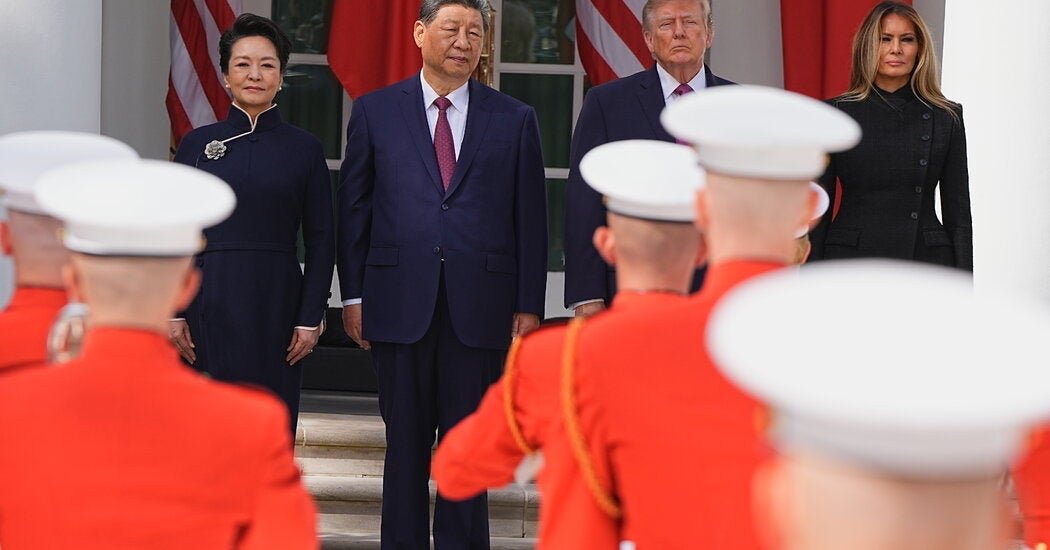

In front of the cameras, President Trump and China’s Xi Jinping have showcased a budding friendship, cemented by state visits, friendly pats on the arm and the occasional shared laugh.
But the public cordiality masks a different reality. Their governments are hardening their economic defenses and putting up new barriers to trade and investment. It has become more difficult for the two countries to invest, trade or do business with each other.
More good will is expected when Mr. Trump arrives in the Chinese city of Shenzhen this week for his third meeting with Mr. Xi this year. Yet the divide between their governments is becoming harder to ignore. Each meeting has been preceded by fresh economic offensives that are driving the world’s two largest economies further apart.
Shortly before Mr. Trump was scheduled to land in Asia, his administration moved to restrict China’s access to advanced artificial intelligence chips through data centers outside its borders, proposing a new rule to close a loophole that experts said would further inflame tensions. On Tuesday, China called the rule a “textbook case of economic coercion and long-arm jurisdiction” that “disrupts the stability of global industrial and supply chains.”
It was the latest in a series of moves from both China and the United States in recent weeks to label new sectors of their economies off limits in the name of national security. Beijing has designated more technologies as strategically vital, placing tighter controls on their export. Washington has proposed barring American investment in Chinese biotechnology, hypersonic weapons and artificial intelligence.
The confrontation has spilled beyond their two countries’ borders into global supply chains. China is building a fortress around technologies and critical materials on which much of the world depends, forcing other countries and multinational companies to contend with the fallout.
“There are more barriers than bridges being built,” said Ben Kostrzewa, a partner at the law firm Hogan Lovells in Hong Kong. “Each of these moves on its own is another brick in the wall and it is becoming harder and harder to invest in the other country.”
The steady buildup of those barriers began nearly a decade ago as a tit-for-tat tariff war during Mr. Trump’s first term. It has evolved into a far broader showdown for economic and technological supremacy.
China, in particular, has shifted its tactics. Once largely content to answer American tariffs and sanctions with reciprocal measures that were often symbolic, Beijing is now going on the offensive. It is wielding its dominance in manufacturing and critical supply chains to remind Washington — and the rest of the world — of the costs of confronting it.
The rivalry reached a low point last year, when both sides imposed tariffs so steep they amounted to a de facto trade embargo. China then threatened to tighten its controls on rare earths, the essential materials used in everything from smartphones and electric vehicles to fighter jets.
In October 2025, Mr. Trump and Mr. Xi eased tensions by agreeing to a truce and reciprocal state visits.
The two visits this year were heavy on ceremony. When Mr. Trump traveled to Beijing in May, he was greeted by military bands and cheering children. When Mr. Xi landed in Maryland in September, he was welcomed on the tarmac by Mr. Trump. There have been raised glasses, shared walks and moments of banter.
After Mr. Xi’s visit two months ago, the two governments agreed to extend their yearlong truce and reduce tariffs on $60 billion worth of goods. Yet neither side formally confirmed the extension until hours before the agreement was set to expire, just a week before Mr. Trump’s planned arrival in China.
Even then, the reprieve was limited. The renewed truce, which suspended certain tariffs and export controls, runs only through January.
And despite Beijing’s pledge to ease restrictions on exports of rare-earth metals and other critical minerals, some American companies still struggle to obtain supplies, said Erin Browne, the U.S. Treasury Department’s under secretary for international affairs.
“We’re making sure that we’re getting equal treatment across companies, across sectors, but also across materials or rare earths,” Ms. Browne said. “The strength of the relationship between our two presidents goes a long way in helping to move that along.”
Yet the personal rapport has done little to restrain an emboldened China, which has signaled it is no longer afraid of escalating economic warfare.
Beijing has strengthened its arsenal of countermeasures against American blacklists of its companies. It has created new legal mechanisms to block foreign sanctions, and Chinese companies have brought legal actions against foreign businesses, including JPMorgan Chase and Citibank, in Chinese courts for complying with American restrictions.
This year, Beijing introduced sweeping rules empowering regulators to inspect corporate records and prevent executives from leaving China if their companies are found to be helping to shift supply chains out of the country.
It has also established a national security review system for foreign investments, using it to block Meta’s $2 billion acquisition of Manus and SoftBank’s $5.4 billion takeover of ABB Robotics.
Together, these developments reflect “a very prominent change” in China’s approach, said Zhao Minghao, a professor at Fudan University. Beijing is assembling legal and regulatory tools built around economic and technological security, he said, and “exploring using actual cases to give these laws ‘teeth,’ so that they can truly be implemented and put to use.”
Its new strategy aims to protect control over the technologies and industries that give it a competitive edge.
Beijing has recently started restricting exports of dozens of technologies related to artificial intelligence, biotechnology and solar power. Under the rules, Chinese companies need government approval before transferring or sharing the covered technologies overseas.
For its part, Washington is seeking to cut off the capital that helps finance China’s technological ambitions. A Treasury Department proposal to expand those investment limits could make investing in broad swaths of China’s technology sector nearly impossible.
“We’re in the early stages of financial decoupling,” said H.K. Park, managing director and national security expert at Crumpton Global.
Analysts in both countries see little prospect of reversing the ever-wider restrictions on trade, technology and capital.
That leaves Mr. Xi and Mr. Trump with a shrinking set of issues on which they can strike deals. When the two leaders meet in Shenzhen, they may find room to bargain over tariffs. But the technologies, investments and critical materials at the heart of their rivalry are becoming harder to negotiate.
“Tariffs are a minor issue,” said Zhou Yong, a partner at the JunHe Law Offices in Beijing. They are among the few areas where both governments can still reach agreement.
“The real sticking points are competition in A.I., high tech, and chips, and China’s export curbs on rare earths,” he said.
“These are higher-stakes bargaining chips that both sides feel difficult to negotiate now.”

