


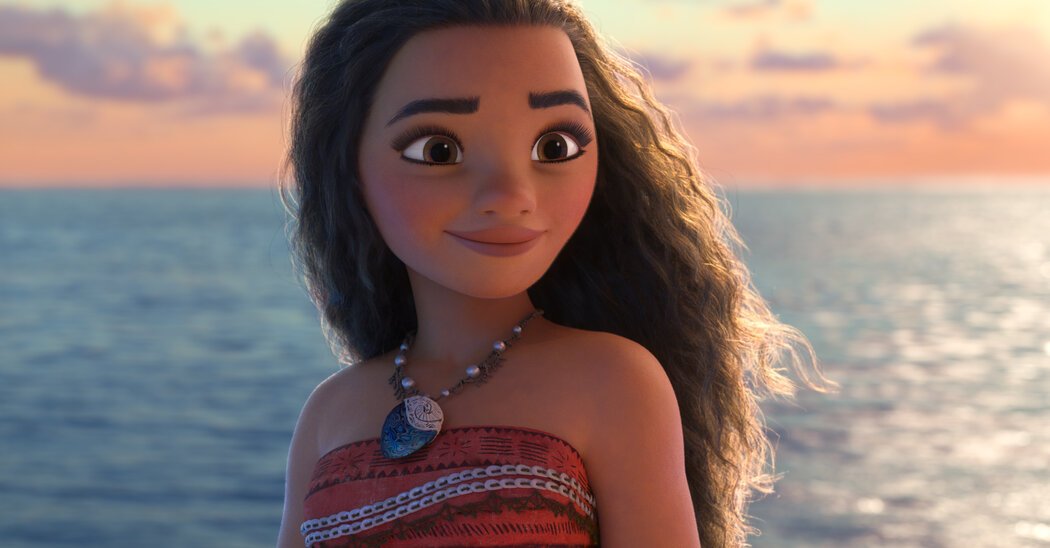

Rory Henry, a 2-year-old in Fort Worth, is in the grip of an obsession.
She’s watched Disney’s animated Polynesian princess movie, “Moana,” around 40 times in the past year and a half. She has a pig toy in the shape of Pua, Moana’s sidekick. A karaoke microphone that plays a song from “Moana 2.” And “Moana” dresses, sunglasses and hair clips.
Rory’s mother, Stacey Henry, 38, and her father have to be careful about using the “M word” around the house, Henry said.
“She’ll immediately get her very serious eyebrows on and say ‘Board my boat,’” Henry said, with a laugh.
Rory is hardly alone: Since its theatrical release in 2016, “Moana,” which is about the daughter of a chief who goes on a journey to save her island from destruction, has become the most watched movie of all time on Disney+. It’s been streamed for more than 1.5 billion hours, the equivalent of playing “How Far I’ll Go” on repeat for more than 170,000 years. Both “Moana” and its 2024 sequel, “Moana 2,” are among Disney’s Top 10 highest-grossing animated films.
So what is responsible for the affliction that hundreds of parents on social media have termed Moana Mania? It’s a malady that will probably affect more families with the July 10 release of the live-action “Moana,” which returns Lin-Manuel Miranda as a songwriter and features Dwayne Johnson in the role he previously voiced, the demigod Maui.
The songs in almost every Disney animated musical film released in the past few decades have been a danger to parents’ peace and quiet.
There was “You’re Welcome,” the jazzy Polynesian show tune that Johnson sang in “Moana”; “Let It Go,” Elsa’s barnburner of a self-acceptance anthem from “Frozen”; and “We Don’t Talk About Bruno” from “Encanto,” another rollicking Miranda number that mixed salsa with Latin pop.
In each case, Disney deployed an age-old formula: Take a narrative with broad appeal, wrap it in hooky melodies and watch the views rack up.
Cristel Antonia Russell, a professor of marketing at Pepperdine University in Malibu, Calif., researches why people like to consume the same stories over and over again. There is a name, she said, for the urge to seek the comfort that comes with watching a beloved show: the paradox of choice.
The concept, which was coined by the psychologist Barry Schwartz in his 2004 book of the same name, underlies a phenomenon sometimes called the Chinese menu effect. When there are too many options, we often revert to a choice that’s familiar, like having orange chicken again.
“It’s the one thing that you know for sure you’re going to like,” Russell said.
The pull is particularly strong with children, said Sam Wass, a child psychologist who directs the Institute for the Science of Early Years & Youth at the University of East London. The repetition of a familiar narrative can help children’s brains process information, build predictions and master the rhythms of language.
The sweet spot for maximum learning, he said, lies somewhere between knowing exactly what’s going to happen and not being able to predict what’s coming next. “Psychologists sometimes call this the Goldilocks zone,” he said.
Because young children have less experience to draw from, they’re able to reach this zone either with a narrative that is predictable or with a more complex story — like “Moana” — that has become familiar through repeated viewing.
“What looks mind-numbingly repetitive to us may, from the perspective of a 3-year-old brain, be exactly the right level of challenge,” he said.
Each viewing allows children to strengthen and refine their predictions, he said. At first, they may simply learn the broad outline of the story. Later, they pick up on emotional expressions, jokes, motives, vocabulary and subtle relationships between events.
“In a sense, they are running the same experiment again and again, but extracting new information each time,” he said.
Which means that, for a nuanced narrative like “Moana” — with its layered, multidimensional story arc — parents might want to make peace with memorizing the lyrics to “You’re Welcome” and “How Far I’ll Go.”
“The more complex the content is, and the younger the brain, the more you have to rewatch something until it becomes too predictable, and you stop learning from watching it,” he said.
This cognitive feedback loop helps explain why children don’t just rewatch films. They also ask to hear the same book repeatedly, insist on eating the same foods, wear the same clothes and sometimes delight in dropping the same spoon onto the floor 20 times in succession.
“From an adult perspective, nothing new is happening,” he said. “But from the child’s perspective, they are refining and testing thousands of tiny predictions every second.”
It’s not just children, either. Adults return to films they may have watched as children for comfort, of course, Russell said. But they also often come to understand themes they may not have grasped when they were young.
“When you rewatch something, the story hasn’t changed, but you have,” she said. “You see it with a new perspective. It’s like, ‘Oh, I didn’t pick up on this little thing before,’ or ‘Oh, I remember enjoying this character so much different when I was a teenager than now that I’m a mom.’”
But why “Moana” specifically, and not, say, “Brave” or “Tangled”?
It’s a triple threat, Russell said: The film features a protagonist “who isn’t your typical blond Cinderella with blue eyes,” a theme of empowerment and “catchy songs and dances that are just pure joy.”
That last factor may be the most significant. Miranda’s infectious soundtrack is stacked with earworms like “You’re Welcome,” “We Know the Way” and “How Far I’ll Go,” which won a Grammy for best song written for visual media.
Memorable songs can greatly help make a narrative irresistible, Russell said.
“You don’t necessarily need to rewatch a musical to reinforce the film experience,” she said. “You can hear a song from it on the radio and still get all the positive emotions associated with rewatching.”
The music is one reason many parents are themselves hooked on all the seafaring and singing. Krizza Mae Matias-Lizardo, a 31-year-old family blogger who lives in Manila in the Philippines, admits to rewatching the film with her husband on occasion after her daughter, Viel Matias-Lizardo, 3, has gone to bed. (Her husband has the songs on his Spotify playlist, she said, and will sing along even when he’s alone in the car.)
Matias-Lizardo also appreciates the film’s positive message for her daughter.
“I love teaching her that being strong doesn’t mean being perfect,” she said. “It means having a good heart, caring for others, reaching for your goals even if it means you’re scared. As a mom, I think that’s a lesson for me as well.”
It remains to be seen whether the live-action film will be able to reproduce this fixation for a new generation. But signs are worrying (if you are a parent not on the Disney payroll, at least): It has the same cast of quirky characters. Johnson and his burly baritone voice are back. Young viewers will get to hear Miranda’s original earworms (and a few new tunes).
Matias-Lizardo, her husband and Viel are planning to see it in the theater the day it comes out in the Philippines, she said.
“We’re so excited,” she said. “I hope they make more.”

