


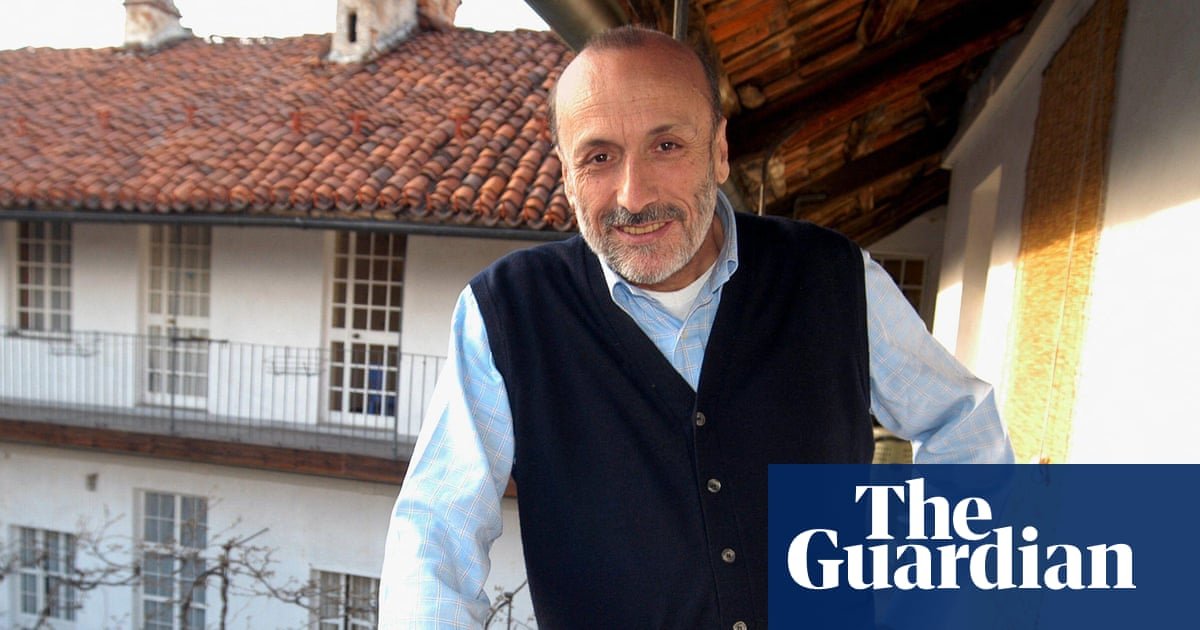

On 20 April 1986, Carlo Petrini was part of a group who cooked and distributed spaghetti to passers-by in Piazza di Spagna in Rome. The huge pot of pasta was their response to the opening, the previous month, of the biggest McDonald’s in the world just metres from where they stood. For Petrini and fellow members of Arcigola, a group dedicated to the pleasures of food and shared political ideals, the opening of McDonald’s in the centre of Rome represented an attack on Italian culinary identity, local biodiversity and the natural rhythms of life: the spaghetti was a declaration of resistance.
A few months laters, during a meeting over dinner at Osteria dell’Unione in Treiso, southern Piedmont, the group came up with the idea of trying to stem the fast food invasion, whose single value was profit. The essayist Folco Portinari, then head of the Rai TV company, wrote the text, while Petrini gathered signatures, and on 3 November 1987, a manifesto was published on the front page of Gambero Rosso, a supplement of the communist newspaper Il Manifesto.
The manifesto began with the title “A proposal aimed at all those who want to live better” and then gave a name to what they saw as the way to achieve this: “Slow Food”. The words that followed were both simple and revolutionary: a call to defend the pleasure of food, food biodiversity and local producers against the standardisation of the global agri-food industry.
The page was illustrated with a snail, a symbol of productive tranquillity, the manifesto signed by 13 writers, intellectuals and artists.
Following its publication and the creation of Arcigola-Slow Food, local groups known as convivia began to emerge all over Italy. Marjorie Shaw, an early member of the Rome convivium that met in an insalubrious hall in San Lorenzo, remembers how farmers, journalists, cooks, teachers and students gathered around a table, animated by the sense that something culturally fragile was at stake. Petrini’s Slow Food revolution had begun.
Two years later, in Paris, more than 20 delegations from around the world signed the official Slow Food manifesto, and Petrini was elected president of the movement – a role he held until 2022, by which time Slow Food was a global network active in more than 160 countries, with 1,500 local branches and youth programmes, 6,000 products protected by the Ark of Taste catalogue, a publishing house and more than 600 Slow Food “presidia” intended to reintroduce supply chains, animal breeds, and plant varieties at serious risk of extinction. What Petrini created was a global system built around three words – good, clean and fair – that offered new ways of thinking about food: not merely as a source of nourishment, but as a matter of environmental sustainability, cultural identity and social justice.
Carlo, known to many by the affectionate diminutive Carlin, was born in Bra, a town in Piedmont, north-west Italy. His father, Giuseppe, a communist from a family of railway workers, who had spent several years in a Russian concentration camp after the second world war, was an auto electrician; his mother, Maria (nee Garombo), a schoolteacher from a farming background.
Following his parents’ wishes, Carlo gave up an academic education for professional training, and enrolled in a technical institute for mechanics. Far better suited to humanities, he failed the mechanical components, recalling the comments following his oral exam as: “Petrini, can you promise never to become a mechanical engineer?” He enthusiastically agreed.
He did, though, work alongside his father in order to support his studies in sociology, attending evening classes in Turin and travelling to Trento University for exams. In a 2025 interview Petrini described missing four of his final exams because there was too much to do; how he returned to Bra to open a grocery shop; became involved with the independent Radio Bra Onde Rosse and local politics; and wrote his first articles about gastronomy for the communist newspapers I’Unità and Il Manifesto.
He became a political and cultural organiser within Arci (the Italian Recreational and Cultural Association), and then was a co-founder with Silvio Barbero of Arcigola.
In 1996 Slow Food organised the first Salone del Gusto, a biannual food and wine Expo that brought together food artisans from all over the world in Turin. In 2004 the Salone gained a new dimension in the form of Terra Madre, a gathering aimed at giving a voice to those often marginalised in the global food system.
Speaking about the need for Terra Madre, Petrini stressed the importance of food education in a post-industrial society where the transmission of knowledge from generation to generation is no longer physical, and of considering the act of eating as both an agricultural and a political gesture. An environmentalist who isn’t a gastronome is sad; a gastronome who isn’t an environmentalist is foolish, he would say.
Later, Petrini would express the same dedication to Orti in Africa, a network cultivating thousands of sustainable community gardens across the African continent, to Slow Food projects in Mexico, to his role as UN special ambassador for Zero Hunger in Europe, and to the challenge to GM foods.
In 2004 education was placed firmly at the centre of Slow Food with the creation of the University of Gastronomic Sciences in Pollenzo, near Bra, the first academic institution in the world to offer an interdisciplinary approach to food studies, an achievement Petrini acknowledged as being a particular source of pride.
Since its founding, 5,000 students from 100 countries have graduated and are now scattered across the world, young people carrying ideas forward and planting – “those who sow utopia, reap reality”, said Petrini. Not least among them is Edward Mukiibi, a tropical agronomist from Uganda, who succeeded Petrini as the president of Slow Food.
A diagnosis of prostate cancer followed Petrini’s decision to step aside from that role in 2022, but he continued to travel in order to listen and communicate about food, always returning to his home in Bra, where he lived with his younger sister, Chiara, who survives him.
He also continued to write, adding to his dozens of published books, which included A Taste for Change (2023), with the economist Gaël Giraud, and Terrafutura (2020), in which Petrini addressed some of the most problematic aspects of our time in dialogue with Pope Francis, with whom he shared friendship and respect, a sense of humour, and hope for a world in which everyone has food that is good, clean and fair.

