



Somalia is entering one of the most dangerous moments in its recent history without an agreed path towards elections or a political transition. United States and United Kingdom-led talks between the government and the opposition collapsed on May 15, the date on which President Hassan Sheikh Mohamud’s original four-year term was due to expire, leaving the legitimacy of key federal institutions under serious strain.
Justin Davis, the US chargé d’affaires to Somalia, and the UK’s ambassador, Charles King, had been trying to persuade political leaders from both sides to reach an agreement on a political transition roadmap. Their failure leaves the country without an agreed way forward at the worst possible time.
Since 2008, Somalia has frequently been ranked as one of the world’s most fragile states. Under President Mohamud’s leadership, the country is now facing a political deadlock that threatens its survival. This crisis is unfolding amid insecurity, humanitarian distress, economic fragility, widespread corruption and shifting geopolitical rivalries.
At the heart of the crisis is the contested nature of the Somali state itself. Somaliland seeks independence, while Puntland and Jubbaland have broken ties with the Federal Government. Al-Shabab controls significant parts of the country and key roads. The Federal Government and at least three Federal Member States are also operating beyond their mandates. The scheduled electoral calendar has lapsed without a vote: parliament’s four-year mandate expired in April 2026, and the president’s term ran out a month later, yet no agreed roadmap for elections or political transition exists to replace them.
In a controversial process, the government unilaterally changed the constitution, passed an electoral law viewed by its opponents as self-serving, and established an election commission they reject as one-sided. Over the past four years, executive, legislative and judicial powers have become increasingly concentrated in the hands of President Mohamud.
Somalia’s national opposition, along with Puntland and Jubbaland, has characterised the government’s actions as a power grab and rejected them. They argue that the 2012 constitution, which reflects Somalia’s political settlement, remains the law of the land. As a result, Somalia is now caught between two competing claims to constitutional legitimacy. For its part, the government maintains that it is advancing a democratic goal long sought for Somalia, a move from indirect, clan-mediated selection to one-person, one-vote elections, and that the constitutional amendments extending the presidential term from four to five years were lawfully approved by parliament.
Universal suffrage and party-based politics remain a distant aspiration for Somalis. Acknowledging this reality, both the government and the opposition continue to accept the clan-based power-sharing system. However, they disagree on how members of parliament representing clans should be selected at the state and federal levels. The government seeks a one-year term extension and proposes an electoral system for clan representatives that critics say would help it maintain its hold on power. The opposition, by contrast, advocates an improved indirect election process through which clans would choose their representatives.
This political rupture is unfolding in a country already facing severe security and governance challenges. Although security in the capital has improved, widespread violence persists, particularly in south-central Somalia. According to the ACLED database, national fatalities reached a record high in 2025, and al-Shabab is responsible for the large majority of conflict deaths recorded over the past two decades. During the current administration’s four years in office, the same data points to tens of thousands of deaths nationwide, primarily concentrated in Banadir, Lower Shabelle, Lower Jubba and Hiran.
The crisis is also taking place against a worsening humanitarian and economic backdrop. Despite the arrival of rains across the country, humanitarian agencies warn that millions of Somalis are food insecure. International humanitarian efforts are struggling to raise funds to assist those affected by poverty, displacement and conflict. Foreign aid has been declining since the Trump administration dismantled USAID in 2025, while Somalia’s domestic revenue-to-GDP ratio remains in the low single digits. Concerns over the viability and affordability of the state have led many to look towards a resource-based economy, particularly as Turkiye expands its involvement in Somalia’s oil and fisheries sectors.
Corruption has further weakened public trust in state institutions. According to the Corruption Perceptions Index, Somalia has consistently ranked among the most corrupt countries in the world over the past decade. Widespread corruption has undermined almost every aspect of governance. The government’s approach to land management has deepened these concerns, with critics accusing it of forcibly evicting people who occupied public lands during the war and selling some of these lands to merchants without due process. Many citizens with legal documents from previous governments have also lost their homes.
These domestic pressures are being sharpened by regional and global rivalries. Somalia is struggling to navigate intensifying competition in the Horn of Africa, the Gulf of Aden, the Red Sea and the western Indian Ocean. Its divided political class is managing these challenges not as a cohesive state, but through regions, clans and rival political blocs. Different groups have aligned themselves with various regional powers and neighbouring countries.
Regional players, including Turkiye, Saudi Arabia, Israel, the United Arab Emirates, Iran and Egypt, are increasingly active in the Horn of Africa. Israel became the first country to officially recognise Somaliland late last year, intensifying competition among rival regional powers and drawing further attention to Somalia and Somaliland amid the region’s shifting geopolitics.
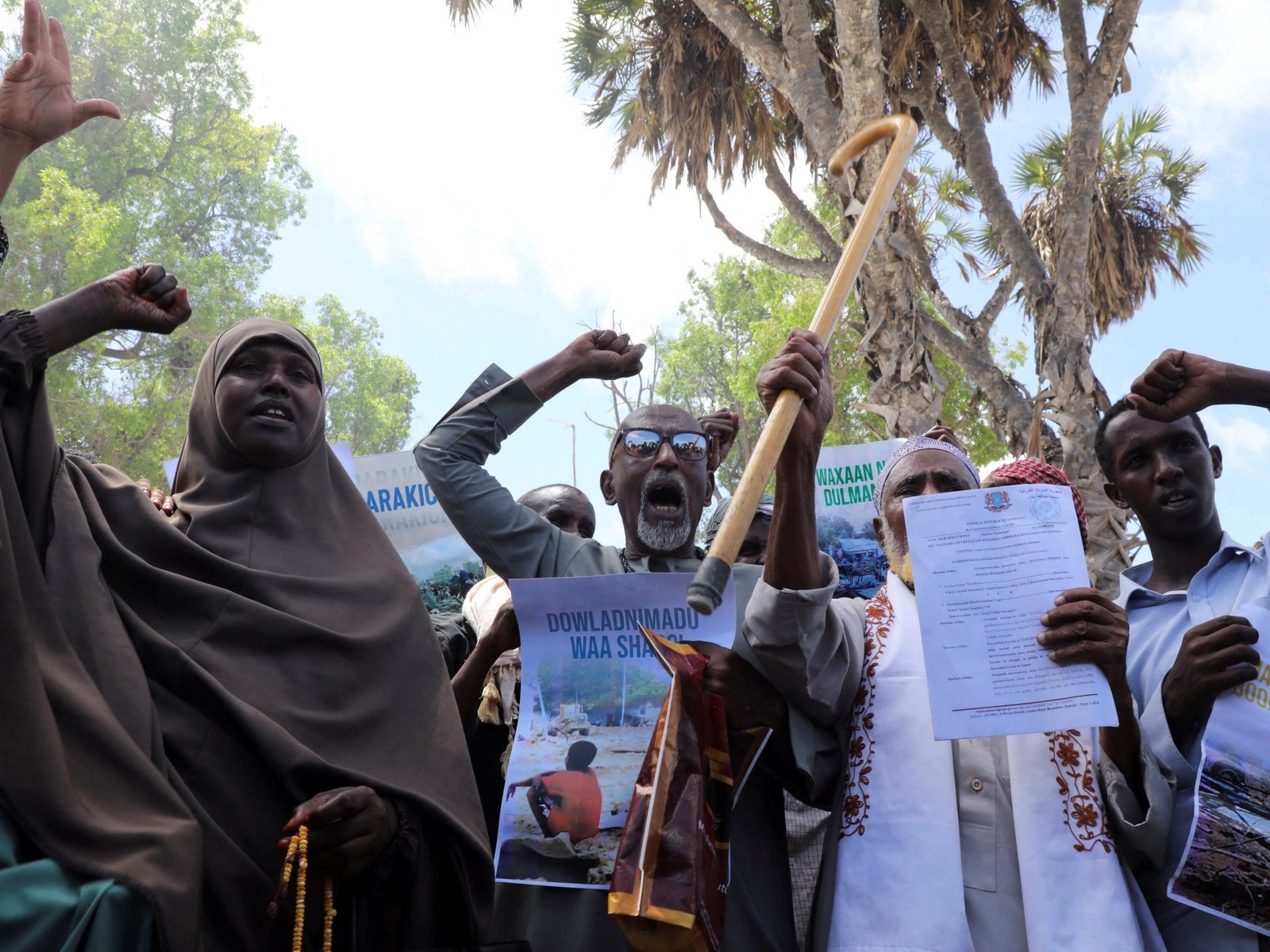
The political, security, economic and humanitarian pressures have also had serious implications for civic space. The government has been accused of silencing dissent by jailing journalists and civic activists. The opposition is now calling for demonstrations, while the government is openly discouraging public participation.
What should happen now
Somalia stands at a critical juncture. Timely intervention by the international community could help redirect the country away from violence and political fragmentation. In the past, traditional donors, mainly the US, the European Union and the UK, helped facilitate Somalia’s last five political transitions, in 2004, 2008, 2012, 2016 and 2022.
The American and British diplomats in Mogadishu made important efforts to bring the parties together and facilitate dialogue, although these efforts came late. A final push may now require more direct involvement from Washington and London, as well as engagement with non-traditional Gulf donors. Turkiye has also expressed interest in contributing to mediation efforts. This should be welcomed, as Ankara has influence with political actors in both the government and the opposition.
The international community should first pressure the government to negotiate a political roadmap in good faith, with a focus on a workable and timely election process. Villa Somalia should also stop using state institutions, including security forces, the aviation agency and international assistance, as tools in the political dispute.
At the same time, the opposition should be encouraged to engage constructively with the government and avoid initiating a parallel process that could lead to the formation of an alternative government. Most importantly, the international community should impose targeted sanctions on political spoilers who use extrajudicial means to destabilise the country.
Beyond the immediate political impasse, there is also a pressing need for genuine national dialogue and reconciliation. Previous peace processes in Djibouti and Kenya involved a wider range of actors in peacebuilding and helped establish the Third Republic. One lesson from those processes is that institutions built by people who have not fully reconciled cannot last. Somalis have never had the opportunity to engage in a serious and inclusive national dialogue. They need an open forum, genuine reconciliation and state institutions they collectively own.
Somalia is on the brink of political disintegration, but it remains at the prevention stage. That is precisely why the broader international community must act now, as it has in the past. There is still time to guide Somalia away from a self-destructive path and safeguard decades of investment in state-building and peacebuilding.
The views expressed in this article are the author’s own and do not necessarily reflect Al Jazeera’s editorial stance.

