


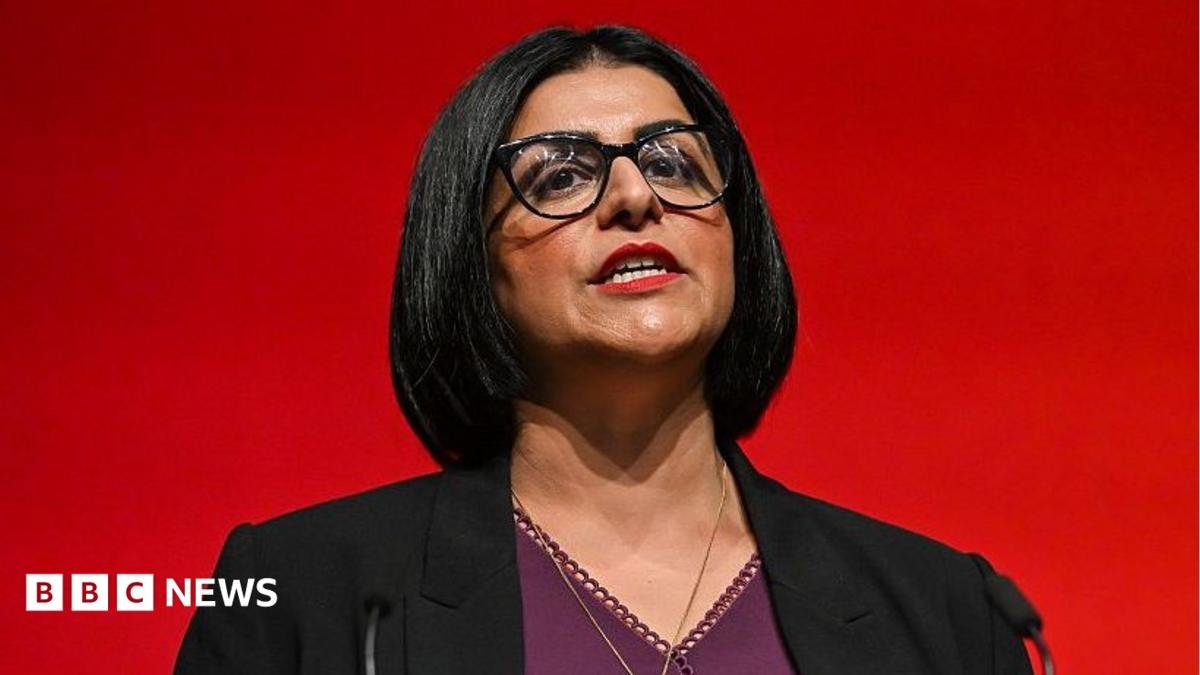

Home Secretary Shabana Mahmood is to announce stronger guidance on police impartiality to tackle what she calls the “corrosive and growing perception of two-tier policing”.
She will tell a conference of police chiefs that they should avoid what she calls “misguided attempts at course correction” where the pursuit of equality leads instead to differential treatment.
Recent complaints about alleged two-tier policing have mostly come from those on the right in politics.
They have pointed to the arrest of Henry Nowak as he was dying after being stabbed by Vickrum Digwa who had accused him of racism.
Reform UK leader Nigel Farage has argued that white people are treated differently by police because of their race. But critics say this claim risks overlooking the long‑standing experiences of black and minority ethnic communities.
Some senior police figures have also strongly rejected the claim of two-tier policing.
Mahmood will announce a new national standard is being developed “to ensure all members of the public are treated equally”, said the Home Office.
“Now let me be clear: I know the vast majority of officers police impartially and that policing without fear or favour is their creed,” she will say.
But Mahmood will announce “clear, comprehensive guidance” on police impartiality, which reinforces that officers must apply the law consistently to avoid what she called “motivated actors” whipping up the idea that there’s two-tier policing.
Mahmood will say that community engagement can mean going to a residents’ association meeting and having tea and biscuits – or samosas – but it shouldn’t mean engaging with activists pushing an agenda.
“Leave the politics to the politicians,” she will say. “And we will leave the policing to you.”
The home secretary will add that more needs to be done to tackle inequalities in policing, highlighting the persistently low proportion of black police officers.
However, she will state that some “well-intentioned approaches”, such as the Police Anti-Racism Commitment, “have risked undermining confidence in impartial policing”.
“As a Muslim home secretary, no one can doubt that equality in policing, and in our forces, matters to me,” she will say.
“But we must also be wary of misguided attempts at course correction, where the pursuit of equality leads instead to differential treatment.
“To the public, it was patently absurd to tell police officers that fair policing “does not mean treating everyone the same”.
Jo Noakes who leads the College of Policing, the standards-setting body for the police, said it will issue new guidance for officers that will make clear on impartiality in Spring.
She said: “Policing must act in a way that maintains public confidence, which is dependent on officers and staff exercising their powers without fear or favour…
“Impartiality cannot be seen in isolation but needs to be considered alongside how policing acts with fairness and inclusion – both in its own ranks and with the public.”

