


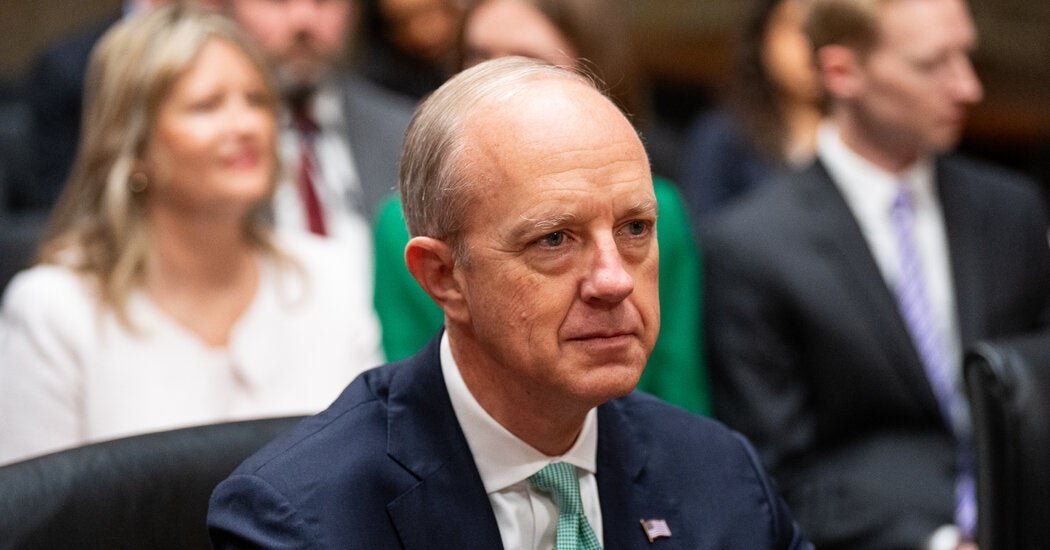

President Trump on Monday nominated Eric M. Ueland, a top deputy at the White House budget office, to serve as the nation’s comptroller general, a move that could hand control of a nonpartisan federal watchdog to one of the administration’s political allies.
If confirmed by the Senate, Mr. Ueland would assume the leadership of the Government Accountability Office, an agency whose responsibilities include monitoring federal spending, identifying government waste and ensuring that the executive branch complies with the wishes of Congress. The post carries a 15-year term.
The selection of Mr. Ueland quickly evoked furious opposition from top congressional Democrats, who accused Mr. Trump of trying to neuter legislative oversight just weeks before Republicans are set to surrender control of Congress.
Mr. Ueland currently serves under Russell T. Vought, the director of the White House Office of Management and Budget, which has worked on behalf of Mr. Trump to block billions of dollars in spending and fire droves of civil workers, often without the explicit approval of Congress. Frequently, the office known as G.A.O. has found some of those activities to be illegal.
The problems date back to the president’s first term, when the accountability office concluded in 2020 that the White House had wrongly withheld nearly $400 million in military assistance to Ukraine. Congressional Democrats would later cite that finding when they commenced a push to impeach Mr. Trump.
But the violations have continued into Mr. Trump’s second stint in office. Repeatedly, the G.A.O. has found that the budget office, where Mr. Ueland is deputy director, has illegally withheld congressionally enacted funds in spite of laws that prohibit the practice, which is known as impoundment
“It would be lunacy for the Senate to hand a 15-year term leading Congress’s nonpartisan watchdog to a Russ Vought acolyte who spends his days plotting new ways for this administration to defy Congress,” said Senator Patty Murray, Democrat of Washington, who leads her party on the chamber’s top appropriations panel.
For years, the Trump White House has forcefully disputed the G.A.O. and its determinations. It has also tried at times to undermine its oversight. Mr. Vought has often attacked the accountability office as partisan, while his aides have recently discouraged federal agencies from responding to its inquiries.
The nomination fit a pattern for Mr. Trump, who has looked to install political loyalists across many federal watchdog posts. And it threatened to neuter a unique agency that is technically part of the legislative branch, even though the president appoints its leader.
Founded in 1921 to advise Congress on matters of the budget, G.A.O. is primarily known for its technical, bipartisan, matter-of-fact reports about the sprawling federal bureaucracy and the ways it can improve.
But the office also has a mandate under law to serve as a watchdog for Congress, protecting its power of the purse. The agency may even sue the administration on behalf of lawmakers to force the release of illegally blocked funds, an extraordinary remedy that its past leader, Gene Dodaro, did not rule out in the months before he retired at the end of 2025.
As a result, many ethics groups joined Democrats in expressing alarm when reports first surfaced that the president was considering Mr. Ueland, who oversaw legislative affairs for Mr. Trump in his first term. Critics feared that his confirmation would choke off one of the primary ways that the legislative branch can keep watch over the president.
Unlike other nominations, the appointment of a comptroller general is supposed to happen only after Congress stands up a formal commission to evaluate, then submit, candidates to the White House. But that did not appear to happen with Mr. Ueland, prompting Democratic leaders including Senator Chuck Schumer and Representative Hakeem Jeffries, both of New York, to attack the administration last week for trying to “install a fox in the henhouse.”
Instead, Senate Republicans began the work to try to confirm Mr. Ueland before the president officially sent his nomination to the Senate. Last week, Senator Rand Paul, Republican of Kentucky and chairman of the Homeland Security and Governmental Affairs Committee, scheduled a hearing for Thursday on “a nominee” for comptroller general.
The panel did not respond to multiple requests for comment.
“The comptroller general is a position that serves Congress, and Congress alone, as we work to identify waste, fraud and abuse, and craft critical reforms to improve the daily lives of Americans,” said Senator Gary Peters of Michigan, the top Democrat on the committee.
Mr. Peters faulted his Republican colleagues for what he described as a “rubber stamp of this nomination in violation of longstanding bipartisan practice.”

