



My home is full of honey pots.
In the front hall hangs a vintage poster from World War II, a sultry blonde at a cocktail party with three British officers leaning over her and the warning: “Keep mum, she’s not so dumb! Careless talk costs lives.”
I also have a Cold War honey trap: a photograph of the bewitching Tatiana Romanova, wearing nothing but a black velvet choker and black stockings, looking up saucily at James Bond after sneaking into his bed in “From Russia With Love.”
On my TV at night is the new season of “Black Doves,” the Netflix thriller in which the comely Keira Knightley is spying on her husband, the British prime minister, and working for a spidery organization that sells state secrets to the highest bidder.
And on my coffee table is a DVD of the 1946 Hitchcock spy noir, “Notorious,” in which Ingrid Bergman honeytraps a Nazi played by Claude Rains. When the Rains character is forced to confess to his Nazi mother that he married an American spy, the mother sneers at him: “We are protected by the enormity of your stupidity.”
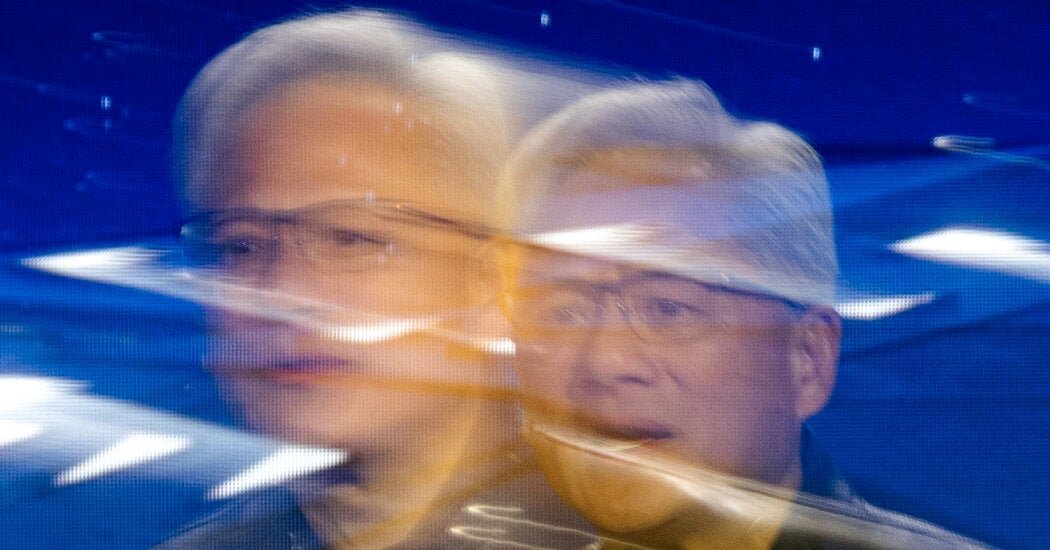
Suffice it to say, Jensen Huang was not protected by the enormity of his stupidity.
Sexpionage in Silicon Valley looks too easy. It barely requires any real tradecraft. All it takes is a smile from the sort of femme fatale these nerdy brainiacs couldn’t get when they were young — before the billions, the makeovers, the personal trainers, the yachts and Huang’s ubiquitous Tom Ford black leather jacket.
Some Silicon Valley executives have warned their scientists and engineers to beware if they find themselves dating women who are “out of their league,” as one tech leader put it to me.
For a 2023 New Yorker profile, Huang told Stephen Witt that he was anything but a player, noting: “I did not have a girlfriend” in high school. His future wife, Lori, was his college lab partner in an introductory electrical engineering class.
Our future is being molded by a sketchy pantheon of stunted tech bros. Many of these boys with toys are immature, awkward and hubristic, high on their own supply, believing themselves to be the gods of a new religion, the creators of a new species.
And Trumpworld is not reining them in — just the reverse. In return for lavish flattery and donations to President Trump’s inaugural fun and pet projects, they’re getting all kinds of leeway, creating threats to national security and a glide path for artificial intelligence to conquer us.
As Julian Gewirtz wrote in The Atlantic, “American strategy has come to depend, to an extraordinary degree, on powerful private-sector actors whose incentives the government cannot simply assume will align with the national interest.”
Though Huang once said at a summit at Stanford that “greatness comes from character,” the lords of the cloud often seem clueless about character, motivations and, indeed, human beings. That’s how Elon Musk threw away close to half a billion dollars on the midterms.
Huang, who went from video games to crackerjack chips that fueled the A.I. boom, dismissed the risks of A.I. and lobbied Trump to lift export restrictions on selling advanced chips to China. Asked if it mattered whether China or the U.S. won the A.I. contest, he said, “I don’t think it does.”
In April, at a $1 million-a-head Mar-a-Lago dinner, Huang made his case to Trump to allow Nvidia to do business with China as the administration weighed an export ban on its chips. The administration shut down sales days after, only for Trump to reverse course a few months later and allow the company to sell certain chips to our chief adversary, provided the government got 15 percent of the revenue.
Trump brays that America can’t slow the pace of A.I. because we have to stay ahead of China. But then he makes perverse moves that will help China catch up to — and maybe overtake — us.
It’s hard to believe Huang wasn’t suspicious of the woman he was involved with, Alice Huang, whom U.S. intelligence identified as a Chinese spy. After all, over a year ago, The Times reported on their cozy friendship, noting that Alice Huang’s firm, Megaspeed, was getting its mitts on billions worth of Nvidia’s most advanced products and distributing them to data centers in Malaysia and Indonesia, and perhaps passing them on to China.
This is a dangerous loophole that Commerce Secretary Howard Lutnick has apparently done nothing to rectify. On Nov. 5, Treasury Secretary Scott Bessent confronted Lutnick, hotly asking why the administration had not already banned chip sales to Megaspeed. Bessent told CNBC on Friday that the Treasury Department had been pushing for it for months. The president, according to The Times, was more sympathetic to Lutnick’s position.
Marco Rubio, a China hawk, began warning top Trump officials this spring about the dangerous liaison of the two Huangs. But Trump, no stranger to risky encounters, brushed it off. He likes rich, powerful, dominating men. And he surely liked hearing Jensen’s happy talk on A.I. because, as everything else around him faltered, the beleaguered president needed the rising stock market, disproportionately buoyed by Nvidia, more than ever.
Trump is a peerless con man, but he’s also an easy mark. He is so eager to have good relationships with Vladimir Putin and China’s President Xi Jinping that he sometimes seems like a patsy.
When A.I. models began blackmailing programmers, giving creepy advice to teens and hacking into other systems, many top tech executives and over 1,000 employees at A.I. companies signed a letter urging that we slow our roll and figure out some guardrails.
Seems like a no-brainer. But Huang wasn’t onboard.
As Witt wrote in The Times, the fallen Nvidia chief liked to present a facade of a humble family man. But in truth, Witt said, Huang was an arrogant narcissist with a penchant for dressing down members of his staff and was reportedly willing to have a widely known affair with a subordinate even though both of his children held senior roles at the company.
The chip king named his company after the Latin word for envy, invidia. But Huang is not someone to be envied; he is someone to hold in contempt. At a perilous moment, when we need to get control over A.I. before it gets control over us, Huang, Lutnick and Trump aren’t looking out for us.
Nvidia, one of the most valuable companies ever, has lost over a trillion in market cap since the spy story broke, causing some headline writers to call this the most expensive peccadillo in history.
Never mind artificial intelligence. What about a little intelligence?

