



The first time someone called P.J. Marley’s in protest, a 16-year-old employee picked up.
From the host stand of the beloved burger joint, he could see the tranquil town square of Medina, Ohio, with its gazebo, twinkle lights and flapping American flags. But on the phone, the caller was screaming.
“They said something,” the teen told his manager afterward, “about pedophiles?”
He could not remember everything the caller said, but he remembered that word, the one that so many people would use to insult the restaurant in the coming weeks.
“Never dining there, vile pedophile supporters,” a woman from a nearby county wrote on Facebook.
“Gross that they chose to give pedophile protectors a platform,” a local woman posted.
The onslaught began in late October, when the Ohio Republican Party announced that a group of candidates who were traveling the state in a big red bus would stop at P.J. Marley’s on the Saturday before the election. One of them, Vivek Ramaswamy, who was running for governor, had just released an ad in which the estranged mother of his Democratic opponent, Amy Acton, called her a liar.
Left unsaid was that when Ms. Acton was 12, her stepfather was charged with raping her, and her mother took the stepfather’s side.
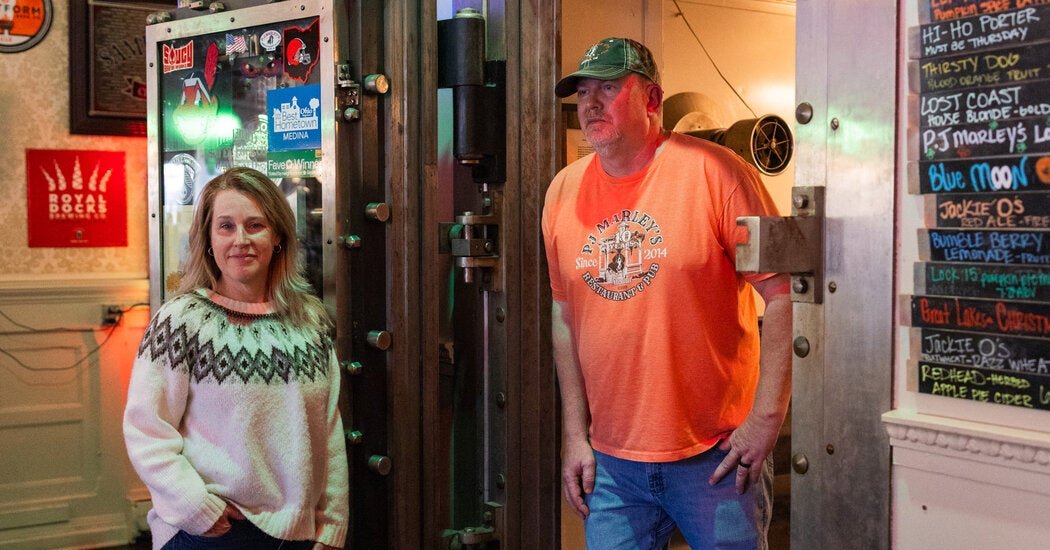
Patty and Jon Stahl, the P and J behind P.J. Marley’s, had agreed to host the candidates before the much-criticized ad was released. They were known around town for raising four sons, volunteering in the local schools and transforming a 122-year-old bank into a tavern. They thought the ad was in poor taste. But as small-business Republicans, they believed in Mr. Ramaswamy’s pitch that he could lower property taxes without harming schools, and thought he could find a way to bring down their rising electric bills.
The couple insisted that holding an event for the Republican ticket was not about taking a side; they would have agreed to host Democrats, too, they said. “People were saying, ‘Oh, you’re giving Vivek a platform,’” Mr. Stahl said. “I looked at it as he was giving us a platform.”
But as the ad kept airing and the calls kept coming, what had felt like a good decision for their business and for civil discourse had instead become yet another battle in America over which side had the moral high ground.
The politicians and pundits who obsessed over the ad and its meaning would move on once the election was over. But as the uproar in Medina would show, the wounds it exposed would not easily heal.
Other businesses that had agreed to hold events for Mr. Ramaswamy were canceling. The Stahls needed to decide if they would, too.
An Inescapable Issue
“Hi Patty, I know it’s been a while,” Stacey Bene typed. She’d just seen a Facebook post about how the candidates were coming to P.J. Marley’s. She’d taken Jazzercise classes from Mrs. Stahl more than a decade earlier, and had said, “I know the owners here” every time she returned to P.J. Marley’s for a bacon burger.
Now, in hopes of persuading Mrs. Stahl to back out of hosting Mr. Ramaswamy, she was going to tell her something she rarely spoke about. In a private Facebook message, she wrote, “I was raped at the age of 14.”
Throughout the election season, the subject of physical and sexual abuse had felt almost inescapable in Ohio’s 7th District. In the congressional race, there were ads accusing Representative Max Miller, a Republican, of abusing his ex-wife and toddler, and ads in which he denied the allegations. In the Senate race, there were ads accusing the Republican incumbent, Jon Husted, of taking money from associates of Jeffrey Epstein, the convicted sex offender who died in jail.
But it was Mr. Ramaswamy’s ad that bothered Mrs. Bene, a retired social worker, the most, she said in an interview.
“I cannot separate you from the messages you are allowing to be spread at your facility,” she wrote to Mrs. Stahl.
It felt as if everyone in town were taking sides. Loyal customers were declaring they’d never again set foot in P.J.’s or the Stahls’ second restaurant. Conservatives who had never been to their establishments said they would now seek them out. A woman whose daughters both worked at P.J. Marley’s for years called for a boycott, which led someone else to call for white liberal women to be deported. A prominent Democrat who knew Mr. Stahl well defended him on Facebook, saying, “remember that people are more than their politics.”
The Stahls deleted every negative comment posted to their social media pages, and remained publicly silent.
Then the county Democrats announced plans for a protest outside the restaurant. In Medina County, where 62 percent of residents had voted for President Trump in 2024, Democrats were accustomed to being outnumbered.
Kellie Biegel, who lives around the corner from P.J. Marley’s, had been in a decade-long feud with her neighbor. The more Trump signs her neighbor acquired, the more pro-liberal signs Ms. Biegel put up.
One day this summer, she realized that all of her neighbor’s signs were gone. Ms. Biegel asked her to come over. They hugged. Hoping to ease the years of tension, she did not bring up politics.
But when Mr. Ramaswamy arrived in town on Oct. 31, Ms. Biegel knew where she would be.
The town square, which had served as a backdrop for a Gilmore Girls festival and a few rom-com movies, was filled with about 200 protesters. A video truck displayed an image of Mr. Ramaswamy and the question, “What kind of man runs this ad?”
Most of the protesters stuck to the square, where a massive sign declared, “KINDNESS WILL WIN.”
But Ms. Biegel joined a group near P.J. Marley’s back patio, shouting directly at customers.
“There they are,” she yelled as she livestreamed. “Pedophile supporters!”
‘How Can You Work for Them?’
Every seat inside P.J. Marley’s was filled. Some customers said they had come to hear the candidates; others just wanted to show support for the Stahls.
The couple had taught their sons that when you make a commitment, you stick to it. They planned to put out a statement expressing their belief in free speech and open dialogue, and saying that candidates and customers of all beliefs were welcome in their restaurant.
But after more and more disparaging messages dinged on their phones, they never posted it.
“Nothing we say at this point is going to make them happy,” Mr. Stahl said.
Inside the restaurant, he could not see the protesters. Ramaswamy aides had papered over the front windows with campaign signs. The thick walls of the former bank stopped the protesters from being heard. But every time an employee stepped outside, they got screamed at, too.
Anthony Buchanan, a bartender at the restaurant, stepped out through a side door to get fresh air. One protester kept yelling to him, “How can you work for them?”
Mr. Buchanan thought of what he could have snapped back: “If you’re honestly asking me that, you’re not aware of the way that life is. I’m a third-grade teacher. I work two jobs. I’m just trying to get my money.”
Instead, he went back inside and served craft beers while the candidates made speeches about the dangers of what would come if Republicans were not elected.
‘Never Give Up’
At 5 a.m. on the day after the election, Mr. Stahl grabbed his phone from his bedside table and checked the results.
Democrats had swept nearly all the statewide races in Ohio. None had flipped Medina County, although Mr. Ramaswamy had won it by a much smaller margin than Mr. Trump in 2024.
It had been nearly two weeks since the calls and messages started coming to P.J. Marley’s, and they had not stopped, even after the event was over. But the Stahls did not regret their decision. Their business had not appeared to suffer, and in their minds, they had shown everyone that they would not be bullied.
It did bother Mr. Stahl, though, how many customers and acquaintances had disparaged him online without ever directly talking to him.
Then again, he’d stopped talking back. Once he’d decided not to post a statement, he had not replied to a single message or email.
After getting out of bed, he took his phone to a chair in his living room and searched for a video of Mr. Ramaswamy’s concession speech.
“It was a tough race,” Mr. Ramaswamy said. “It was bitter at times, in both directions.”
But now it was time, he went on, “to bring Ohio together.”
Then Mr. Stahl watched Ms. Acton.
“The healing begins today,” she said. “We must never give up on one another.”
On Facebook, there was a new message notification.
“Oh well,” someone had written. “You ruined your business over a loser!”
Mr. Stahl tapped the name of sender and clicked block.
Kitty Bennett contributed research

