




Tuesday’s blue wave didn’t resolve either party’s internal divides. In fact, The POLITICO Poll shows they may even get worse.
Even ahead of Election Day, Republicans were already torn over how much to blame President Donald Trump for the scale of the defeat, weeks of polling show. While Trump distances himself from the electoral blowout — saying the loss was because he wasn’t on the ballot himself — some Republicans are beginning to weigh what a post-Trump GOP looks like.
Democrats, on the other hand, have scored a large-enough victory that instead of being united, nearly all factions of the party can claim it as evidence of support for their agenda, according to the surveys conducted by PF Global. Tuesday’s decisive wave, therefore, has done little to move them past the moderate and progressive infighting that has shaped much of this cycle.
One thing is clear: Both party’s leaders have a lot of work to do to stitch together a winning coalition ahead of a critical 2028 presidential race.
Here are some key takeaways from what voters were telling us right before they delivered a historically heavy blow to the president. (We’re polling them again soon to see how they may have shifted in the wake of the election.)
Republicans voters were torn over whether the midterms would divide their party
Before the elections, Republican midterm voters told The POLITICO Poll they were confident about a victory in the House and the Senate. Despite that, 29% felt that the GOP would come out of the elections more divided, while another 29% said it would come out more unified.
That’s compared with 45% of Democratic voters who said they expected more unity in their party after the election results — even before they knew what would happen.
Republican strategists and lawmakers have already issued stark warnings about the future of the GOP if the party doesn’t learn from voters’ frustrations with the economy, the Iran war and the Trump administration.
“Tonight’s shellacking should be a wake-up call,” Sen. John Curtis (R-Utah) wrote in a lengthy Substack post on Tuesday night. “But if our response is to blame the media, the polls, or the voters, we’ll have learned absolutely nothing. We might start by looking in the mirror.”
Trump’s coalition shattered — and many of his voters want to distance from him
Some Republicans are directly blaming Trump, who saw his coalition shatter on Tuesday night. The blue wave spared no region: Red counties and blue counties, Hispanic-heavy counties and white counties, urban areas and suburban areas all shifted to the left.
The POLITICO Poll shows there’s been a critical split between Trump voters who identify as MAGA — his most loyal supporters — and those who don’t, who make up the softer part of his 2024 coalition.
A majority of MAGA Trump voters said they would see a midterm election loss as a reason to move closer to Trump’s agenda. Non-MAGA Trump voters said the opposite: For them, a defeat in the House and the Senate was a reason to break away.
The fracture will persist beyond the election results — and it reflects the fact that Republicans’ voter base has been falling apart on a number of issues over the course of the last year. The POLITICO Poll has repeatedly shown that non-MAGA Trump voters break away from their MAGA bedfellows on everything from affordability to ICE to the war in Iran to data centers.
“It’s time to consider what life is going to be like after Donald Trump,” said Jonathan Fletcher, register of deeds and former GOP chair of Gaston County, North Carolina, where failed Senate nominee Michael Whatley’s watch party was held. “Trump has done some excellent things, and I appreciate that, but it can’t be the party of Trump forever.”
Democrats are not on the same page about what major wins mean for party direction
The Democratic Party needs to brace for some fiery discussions of its own. Our polling showed that the scale of the victory would shape the direction Democratic voters would want to see from the party.
A plurality of Democratic midterm voters said a massive victory Tuesday would be a reason to run progressive candidates.
But that was driven by self-identified progressives, 61% of whom take that position. Moderate Democrats were more torn, with 35% saying the party should run more progressives in that scenario, and 36% saying the party should run moderates.
Already in the aftermath of the election, both sides of the party’s ideological civil war began to claim victory.
“As the Democratic Party looks to the next presidential election, the lesson from this cycle is unequivocal: high-quality Democrats in the middle were the majority makers in 2026 — and they are the model for 2028,” the centrist Democratic group Third Way wrote in a memo published Wednesday.
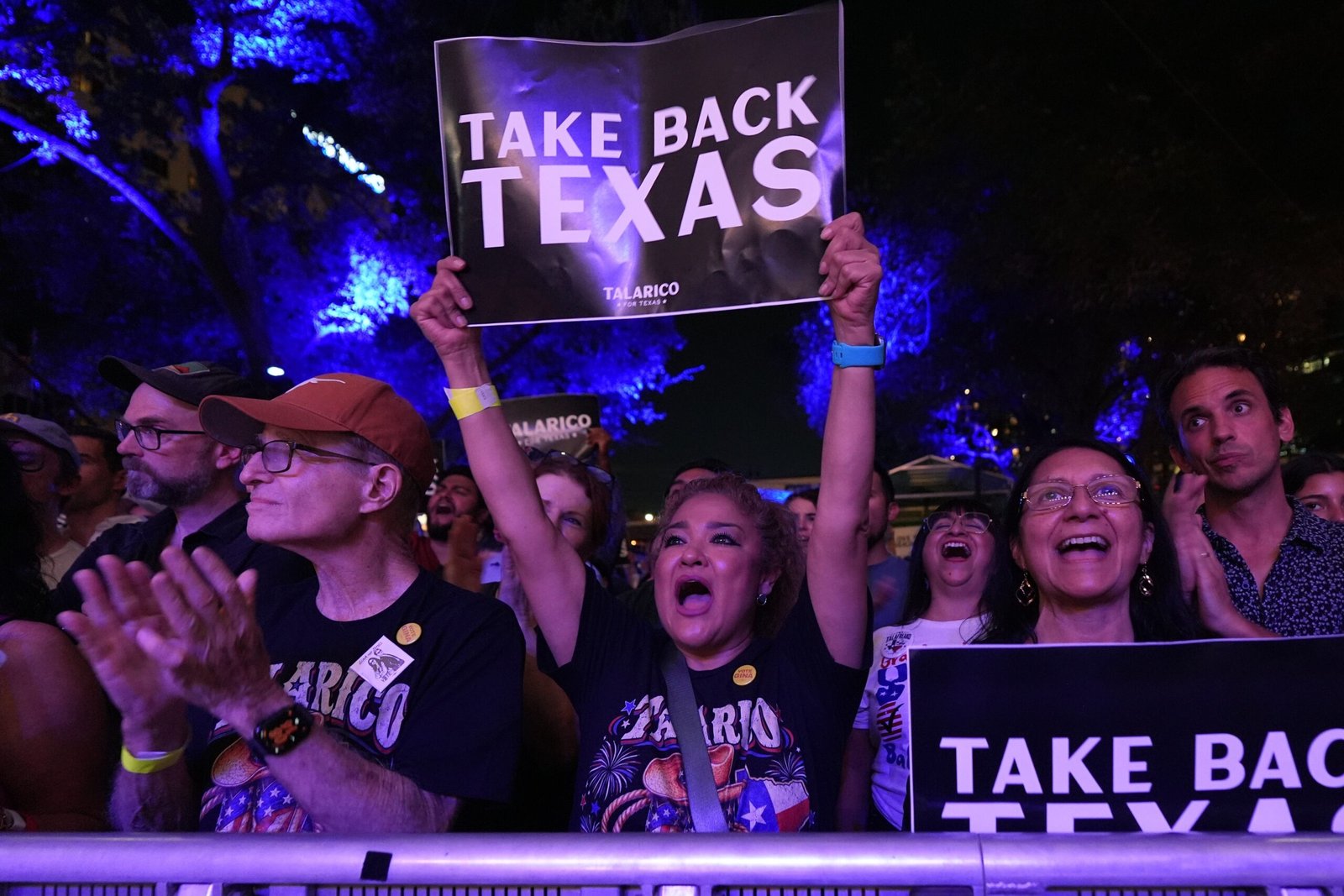
Moderates are pointing to Democratic wins in red-states — from Adam Hamilton for Kansas Senate to James Talarico for Texas Senate to Josh Turek for Iowa Senate — as examples of the middle-of-the-road approach they need to take to hold onto those victories and set themselves up for 2028.
The Progressive Change Campaign Committee, for its part, argued “labels like ‘moderate’ and ‘progressive’ obscure a clear throughline,” according to a memo published after the election. “The center of gravity in the Democratic Party has shifted in an economic populist direction.”
They have their own wins to point to, including Troy Jackson in the Maine Senate race and Abdul El-Sayed in the Michigan Senate race.
There’s another core problem for Democrats: It looks likely that the strongest coalition they built was centered on backlash to Trump. Even in the final POLITICO Poll before the election, over half of Democratic voters (53%) said they were casting their ballots to vote against Trump, rather than for or against their local candidates.
That means the Democratic Party has work to do to ensure their new voters stick around once Trump is gone.
Seb Wride is the head of polling at PF Global, the London-based firm that runs The POLITICO Poll.

