


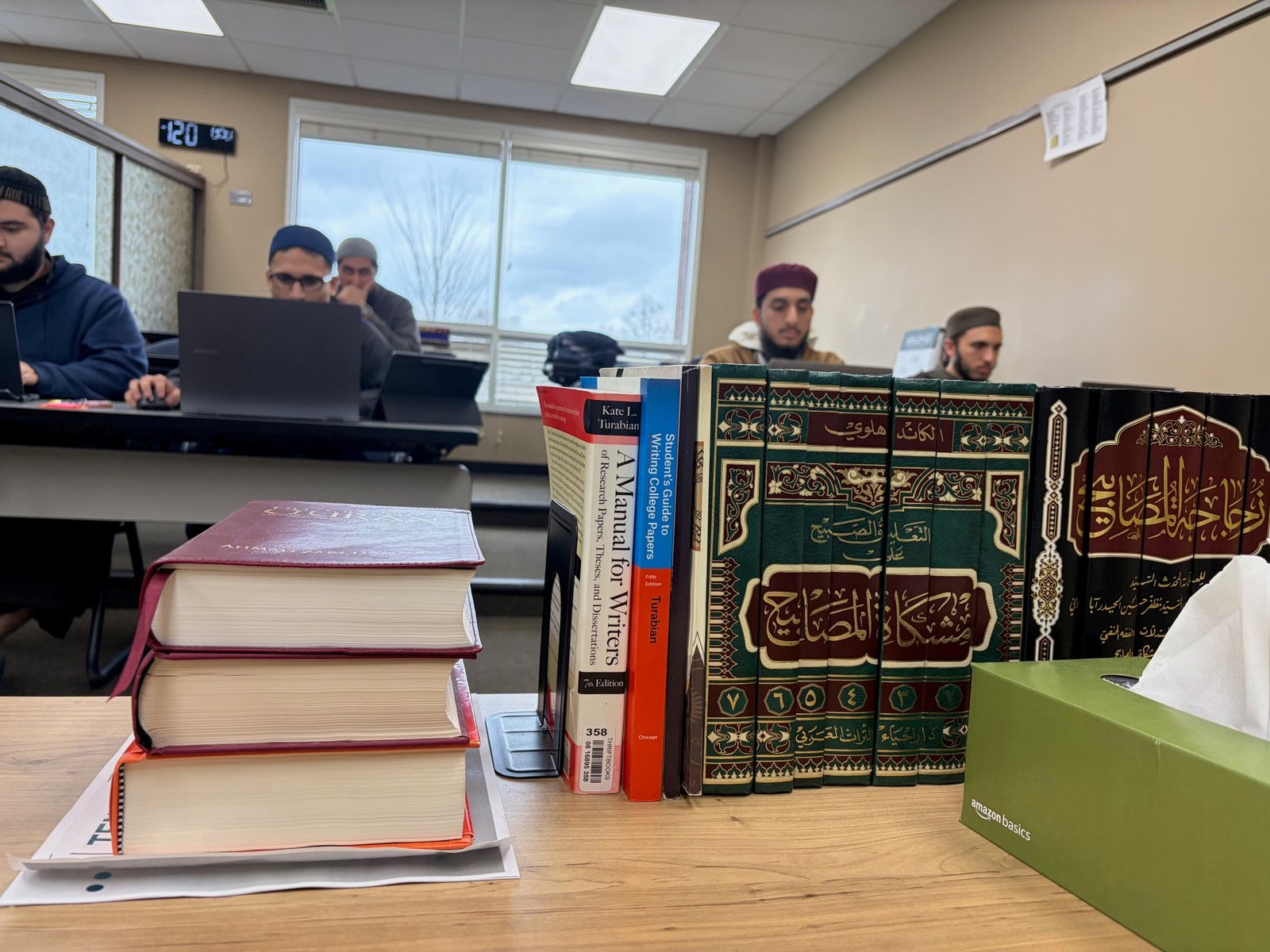

Darul Qasim’s influence extends beyond its own classrooms through scholars who now teach and lead communities across the Chicago area.
For Imam Haroon Ahmed, a graduate of the college who now serves as director of Islamic affairs at the Islamic Foundation, overseeing its mosque and school, the impact is measured through individual lives rather than institutional reach. Much of his development as a scholar and imam, he says, was shaped and tested during his years at Masjid Uthman and Uthman Academy, a mosque and Islamic school serving Chicago’s western suburbs.
After Jummah, the Friday congregational prayer, Ahmed remains in the prayer hall at the Islamic Foundation as most of the community files towards the doors. A handful of people, young and old, stay behind near the front. Some settle onto the carpet, backs against the wall, phones facedown beside them. Others linger at the edge of the gathering before eventually stepping forward. As the hall empties and grows quiet, those with the most personal questions often wait until everyone else has left before they speak.
Since Israel’s genocidal war on Gaza began on October 7, 2023, the external pressures have been, in Ahmed’s words, real: heightened scrutiny, emotional volatility, strong expectations pulling from multiple directions. What concerned Ahmed most was not his own steadiness but what was happening to the young people in his community. They were absorbing narratives of suffering and injustice in real time through social media and school corridors and dinner table arguments while simultaneously trying to answer questions about who they were.
The conversations often returned to the same themes: Why is there evil and suffering in the world? Why do Muslims endure hardship if they believe they are following the true path? Am I primarily American or Muslim?
The conversations often returned to the same themes: Why is there evil and suffering in the world? Why do Muslims endure hardship if they believe they are following the true path? Am I primarily American or Muslim?
“These conversations became especially pressing when many young people were wrestling not only with theology but with belonging and moral clarity.”
His instinct is not to answer immediately.
Instead, he says, his years at Darul Qasim taught him to slow the conversation down, locate each dilemma inside a tradition of thinking, and encourage reflection rather than reactionary responses.
He calls it “internal immunity”. That’s not immunity from hostility but from allowing hostility to dictate who you become.
“The only true vulnerability is stagnation,” he says.
When Ahmed explains where that instinct comes from, he traces an intellectual lineage stretching back centuries.
It begins with Shah Waliullah al-Dihlawi, the 18th-century Delhi scholar who argued that revelation, ethics, law and human welfare were never separate disciplines but parts of the same moral whole. His ideas have shaped Islamic scholars from Nanautavi to Kholwadia.

And Ahmed believes they continue to shape the students filling Darul Qasim’s classrooms today.
Lateef still spends his days where he always has: beside people whose lives are drawing to a close.
Death has not become any less complicated. Families still wrestle with impossible decisions. Patients still seek answers that medicine alone cannot settle.
The difference, he says, is that those questions no longer leave him feeling untethered.
“There must be a knowledge source beyond what can be originated from human capacity,” he says. “A suprarationality that helps shape our rationality.”
For years, Lateef feared he might spend a lifetime mastering one body of knowledge while remaining a stranger to another.
That fear has not disappeared entirely, but now it has somewhere to go.
Every Saturday, he makes the drive to suburban Chicago, joining doctors, lawyers, teachers and students who have all arrived carrying versions of the same unease: the sense that the education that made them successful had left another education untouched.
This time, he is not making the journey alone.

