


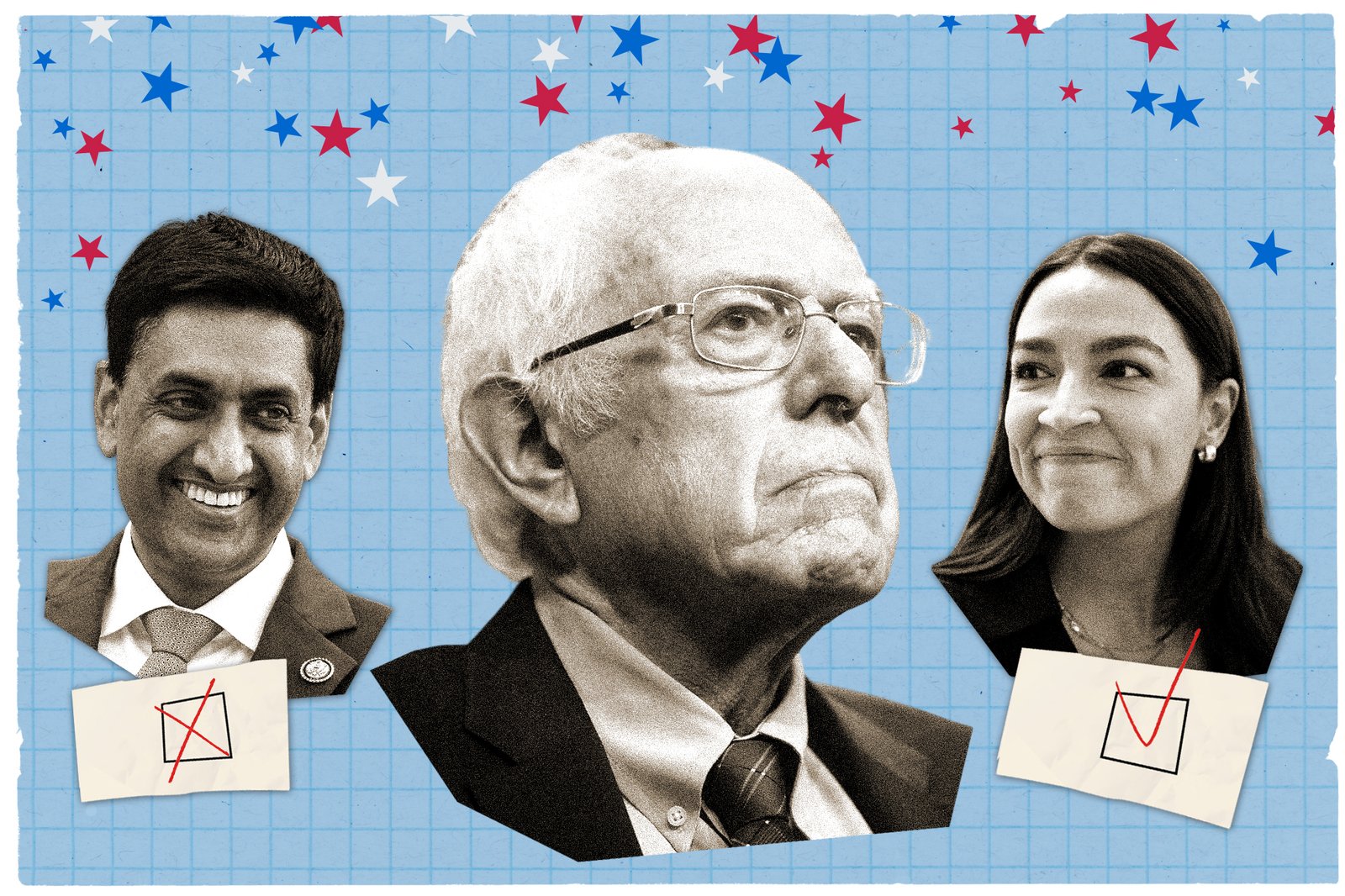


The battle to become the country’s next progressive leader in the mold of Bernie Sanders is heating up ahead of Democrats’ direction-defining Michigan Senate primary.
Nowhere is the jockeying and strategy unfolding behind the scenes more pronounced than between Democratic Reps. Alexandria Ocasio-Cortez of New York and Ro Khanna of California, who have taken disparate approaches to the midterms as they build out their political brands. Khanna’s go-everywhere mentality versus Ocasio-Cortez’s more selective involvement in key races this cycle will test their political acumen and relationships, potentially setting them up for a 2028 presidential race that could decide who will inherit the movement.
In much of Sanders’ inner circle, who comes next is pretty obvious, even as the wider progressive movement continues to clash over the answer.
“It’s always been clear that AOC is the heir,” one person close to Sanders who’s been involved in such conversations with him for years, granted anonymity to share their understanding of the private discussions. “Always.”
Yet within the broader Sanders coalition, there is plenty of behind-the-scenes posturing — and outright bickering — over who will ultimately take over for the Vermont senator. Khanna’s allies say Ocasio-Cortez is playing it too safe to be the next standard-bearer, with some prominent left-wing leaders irked by her sparing endorsement strategy.
Ocasio-Cortez’s and Khanna’s diverging paths are on full display in Michigan, where Democrats’ most contentious Senate primary is coming to a head Tuesday in a critical battleground that will have outsized importance in selecting Democrats’ next presidential nominee.
Both representatives and Sanders have backed Abdul El-Sayed, a progressive former public health official who has surged in polls against establishment-backed Rep. Haley Stevens as he consolidates support among the left.
But only Ocasio-Cortez has appeared alongside Sanders in stumping for El-Sayed, with the two holding a joint rally in Lansing, Michigan, last month. Ocasio-Cortez and Sanders are featured prominently in one of El-Sayed’s closing television ads, in a key sign of who the campaign thinks can best help push him over the finish line.
Khanna, meanwhile, cut a separate digital fundraising appeal for El-Sayed and has campaigned for him without Sanders.
Sanders and Khanna do maintain a relationship — the California representative was a national co-chair of Sanders’ 2020 presidential bid — but there’s doubt within the Vermont independent’s orbit over how successful a Khanna presidential run would be or whether he’s best positioned to inherit the progressive throne, should Ocasio-Cortez choose not to run for president in 2028.
“Ro is basically already running, but not many are taking him too seriously as the movement’s next leader,” said another operative close to Sanders, granted anonymity to speak candidly.
In an interview, Khanna brushed off the notion that there’s a single heir to the Vermont senator’s progressive movement. “I believe that Sanders is going to have many successors over decades, and the key is to build a majoritarian progressivism that can win across the country,” he said.
Asked whether an Ocasio-Cortez presidential bid would change his calculus, he answered flatly: “No.” His decision, he says, will come “around Thanksgiving.”
A representative for Ocasio-Cortez declined to comment. Sanders, for his part, is trying to rise above the jockeying.
“The presidential election is in 2 years and 3 months,” Sanders said in a statement. “Let’s focus now on how we resolve the urgent issues facing our country. There is plenty of time to worry about possible presidential candidates.”
Why Sanders world sees AOC as the successor
Sanders, 84, and Ocasio-Cortez, 36, share a deeply personal bond their advisers say transcends politics but remains rooted in their shared ideals. They talk directly about key policy, political ideas and candidates to boost, and they even coordinated their endorsements around a group of New York democratic socialists and progressives who ultimately won House seats.
The two also share a circle of advisers, including Faiz Shakir and Mike Casca. Casca, a former long-time Sanders aide, now serves as Ocasio-Cortez’s chief of staff and plays a major role in shaping policy and political strategy. Shakir is an adviser to Sanders and executive director of More Perfect Union, a progressive nonprofit media organization.
“I’m sure there are a lot of people who are interested in being the next Bernie Sanders, I think he’d be less inclined to give them his endorsement” over Ocasio-Cortez, said a third person close to Sanders, who’s been involved in the conversations around his political and policy strategy for years, granted anonymity to discuss them.
Sanders and Ocasio-Cortez have approached the midterms differently. The Vermont independent has worked to expand his endorsement roster and his presence on the campaign trail this year, which his allies see as an effort to cultivate a lasting generation of progressive leaders to carry on his movement. He often endorses early, acting as a validator for left-leaning candidates’ campaigns and platforms, while Ocasio-Cortez has been serving as more of a closer.
It’s a strategic shift for the New York Democrat, who used to get involved in races earlier — a calculus advisers say is a recognition of her ability to mobilize certain voting blocs, like communities of color and working-class voters, late in the game.
They don’t coordinate on every contest, but they have joined forces in several races — including El-Sayed’s Michigan Senate race and Sam Forstag’s House primary in Montana. Ocasio-Cortez called Sanders as soon as she decided to endorse El-Sayed and they immediately began planning a rally for him, according to a person familiar with the discussions and granted anonymity to describe the private conversations.
Earlier this year, Sanders and Ocasio-Cortez together also developed the leading progressive push to address artificial intelligence. Sanders was the first member of Congress to call for an AI moratorium, and he helped shape Ocasio-Cortez’s stance. The pair unveiled joint legislation in March to ban the rapid build up of data center construction.
Months later, the issue is now cutting across progressive and conservative voting blocs, is a preeminent policy issue on Capitol Hill and is at the heart of dozens of midterm races and even early 2028 presidential talk.
“Congresswoman Alexandria Ocasio-Cortez and I understand what is at stake,” Sanders said as he introduced the AI moratorium bill alongside the New York Democrat this spring in the Senate.
Progressive candidates whose campaigns have received nods from both Ocasio-Cortez and Khanna say they are both key validators who carry different appeal.
Khanna has risen in prominence because of his push to release files on Jeffrey Epstein. And Ocasio-Cortez brings the kind of star power and nationalized spotlight that campaigns say is invaluable for growing candidates’ exposure, particularly among younger progressive voters who can be trickier to turn out.
“AOC’s very popular, she has a lot of grassroots support … all across the country,” said Adam Hamawy, who was endorsed by both representatives in his New Jersey House primary this spring. “Ro Khanna has not just progressives, but he’s had a strong stance against corruption. … There’s a lot of overlap but each of them have specific things that come together to paint a wider picture than if I just had one.”
Don’t count Ro out yet
Not everyone around Sanders is sold on Ocasio-Cortez as the heir apparent. Khanna allies argue he’s the one who has been putting in the work — and sticking his neck out for the progressive movement — by backing primary challengers to incumbents, getting out front on issues like the Epstein files, and recently traveling to the West Bank.
“People who are supporting her are supporting her more as a brand,” said one Khanna ally and Sanders world operative, granted anonymity to discuss private conversations. “What does it mean to work with her? What does it mean for her to pass a bill? I don’t know her theory of change.”
There is fear Ocasio-Cortez is “weirdly isolating herself” over the years ahead of a 2028 decision, the operative added. “I could not tell you who AOC’s advisers are at this point [beyond Casca]. If you’re thinking of running for president, you want to be in an expansive, elevated, exciting space, not in a controlled environment.”
Ocasio-Cortez has been significantly more selective in her endorsements than either Khanna or Sanders, backing left-wing candidates across several competitive House primaries but steering clear of some of the messiest contests on the map, including Maine Senate and Wisconsin’s imploding gubernatorial primary.
That approach has drawn consternation from some on the left who say she’s playing it too safe given her political cachet, particularly as she declines to join other progressives in endorsing against incumbents — notably in her own backyard — even though that’s how she won her seat in 2018.
“Who cares about your win-loss ratio? What I care about is, are you trying to help fellow progressives or aren’t you?” said Cenk Uygur, a Khanna supporter who founded the progressive online network “The Young Turks” and Justice Democrats.
“AOC cares so much about her colleagues, and her colleagues are establishment Democrats. I don’t care about them. In fact, I’m opposed to them,” Uygur added. “I want them challenged in primaries.”
Khanna has worked to keep his own close ties to Sanders and his circle.
Jeff Weaver, Sanders’ 2016 campaign manager, now serves as a senior adviser to Khanna as he’s pushing to be a high-profile progressive leader and laying the framework for a possible 2028 presidential run.
“No two candidates are equal,” Weaver said. “But I think Ro Khanna has the chance to do what Bernie did, which is to have appeal beyond the Democratic base.”
Khanna has spent years trying to build the kind of early-state infrastructure a presidential campaign requires, traveling to early primary and battleground states to lay the organizational groundwork for a potential run. Since 2021, he has been working to assemble steering committees of 75 to 100 people in New Hampshire and Nevada, with another being built in South Carolina, while working with local political power players, according to Shannon Jackson, another longtime Sanders operative who is now consulting for Khanna.
Over the last week, the California representative has been on what he is calling an “new economic patriotism tour” through Pennsylvania, holding events in counties Trump carried like Erie, Luzerne and Cambria “There is a great desire for a bold, progressive vision that is going to call out an unfair and rigged political and economic system,” he told POLITICO. But the test, Khanna argued, is making that vision work “not just in the Bay Area, not just in Michigan, not just in progressive areas, but in places like Pennsylvania.”
Khanna has endorsed dozens of candidates up and down the ballot this year, wading into some of the most fraught Democratic House, Senate and gubernatorial primaries in the country.
That widespread involvement has produced a mixed track record with some high-profile losses, including Graham Platner’s disgraced exit from Maine’s Senate primary and Tom Steyer’s expensive loss in the California governor’s race. In the case of Platner, Khanna and Sanders endorsed the Maine progressive, while Ocasio-Cortez, notably, stayed out of the race altogether.
Khanna also has backed candidates against the Democratic Congressional Campaign Committee and establishment. For example, Khanna-endorsed progressive Matt Dunlap in Maine’s 2nd Congressional District successfully defeated the DCCC’s preferred candidate.
“There’s a difference between being a progressive in policies and being a progressive in action,” said Uygur. “And action requires you challenging the system, challenging the establishment. On those grounds, it’s not close. Ro Khanna is head and shoulders above every other Democrat.”

