




 Zoe Corbyn
It doesn’t get much more remote than this. I’m in inland Western Australia, at Rio Tinto’s Greater Nammuldi iron ore mine.
It’s about a two-hour flight north from Perth in a region called the Pilbara.
No-one lives permanently here. Around 400 workers are on the site at any one time, and they are flown in, working between four and eight days, depending on their shift pattern, before flying home.

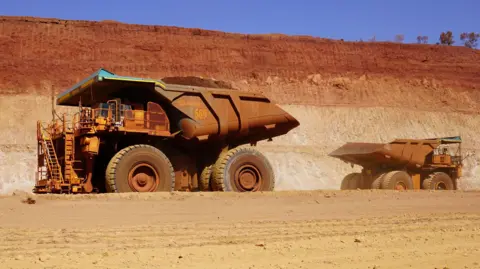
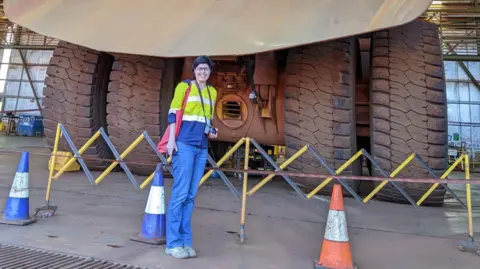
Giant trucks the size of townhouses, capable of hauling 300 tonnes, criss-cross red-earth roads in various sections of this open-pit mine complex.
For an outsider like me their size is intimidating enough, but multiplying that feeling is the knowledge that there’s no driver at the wheel.
During a tour of the site in a normal-sized company vehicle, one of the trucks comes into view, approaching from a side road.
I sigh with relief as it deftly turns and continues in the direction we have just come. “Did it make you feel uncomfortable?,” asks the vehicle’s driver Dwane Pallentine, a production superintendent.

 Zoe Corbyn
 Greater Nammuldi has a fleet of more than 50 self-driving trucks that operate independently on pre-defined courses, along with a handful that remain manually driven and work separately in a different part of the mine.
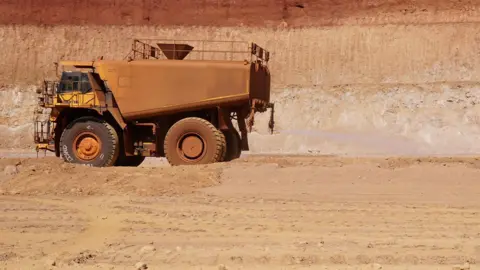
Being trialled is also an autonomous water cart affectionately known as Henry, which, along with manually driven ones, sprays the mine roads to keep the dust down.
The company vehicle I am in is able to operate alongside the autonomous trucks only because it has been fitted with high-accuracy GPS, which allows it to be seen within a virtual system.
Before entering the mine’s gated autonomous zone, we logged onto this system and a controller verified over the radio that we were visible.
It has encased our vehicle in a virtual bubble that the self-driving trucks “see” and which causes them to manage their proximity by slowing or stopping as necessary.
A touch screen in our cabin displays all the staffed and autonomous vehicles and other equipment in the vicinity, along with “permission lines” that show the immediate routes the self-driving trucks are intending to take. Had I looked at the screen instead of fretting I would have seen that truck was going to turn.
In addition to all vehicles being fitted with a big red emergency button that can stop the system, the autonomous trucks have lasers and radars front and rear to detect collision risks.
The sensors also detect obstacles. If a large rock fell off the back of a truck, the sensors on the next truck along would notice it and the vehicle would stop.
However, some trucks seem extra sensitive – on my tour I see a couple foiled simply by rough roads.
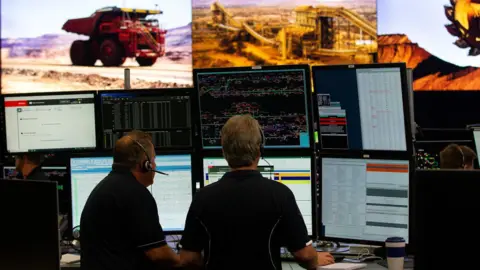
Co-ordinating and monitoring these robots is Rio Tinto’s Operations Centre (OC) in Perth, about 1,500km (930 miles) to the south.
It’s the nerve centre for all the company’s Pilbara iron ore operations, which span 17 mines in total, including the three making up Greater Nammuldi.
Guided from here by controllers, include more than 360 self-driving trucks across all the sites (about 84% of the total fleet is automated); a mostly autonomous long-distance rail network to transport the mined ore to port facilities; and nearly 40 autonomous drills. OC staff also remotely control plant and port functions.
Autonomy isn’t new to Rio’s Pilbara operations: introduction began in the late 2000s.
Nor is it unique: Australia has the greatest number of autonomous trucks and other mining equipment of any country, and other mining companies in the Pilbara also use the technology.
But the scale Rio has grown its operations to here, including at Greater Nammuldi – which has one of the largest autonomous truck fleets in the world – gives it global significance.
And it’s a global trend. According to GlobalData the number of self-driving haul trucks worldwide has roughly quadrupled over the past four years to more than 2,000, with most made by either Caterpillar or Komatsu.
 Rio Tinto
The biggest reason for introducing the technology has been to improve the physical safety of the workforce, says Matthew Holcz, the managing director of the company’s Pilbara mines.
Mining is a dangerous occupation: heavy machinery can be unpredictably operated by people who can also become fatigued. “The data clearly shows that, through automation, we’ve got a significantly safer business,” says Mr Holcz.
It has also improved productivity – to the tune of about 15%, he estimates. Autonomous equipment can be used more because there are no gaps due to shift changes or breaks. And autonomous trucks can also go faster when there is less staff-operated equipment on the scene.
Such automation does not come cheap. Rio won’t disclose what it has spent in total on its Pilbara automation journey to date, but observers put it at multiple billions of dollars.
Meanwhile, employment opportunities have evolved. The narrative might be one of robots taking jobs, but that doesn’t seem the case here so far.
While the OC has about one controller for every 25 autonomous trucks – according to Rio, no one has lost their job because of automation.
Instead, there have been redeployments: truck drivers have joined the OC as controllers themselves, been reskilled to operate different pieces of equipment, such as excavators, loaders and dozers, or gone to drive manual trucks at different sites.
On the OC’s large open plan floor, amid the banks of monitors arranged in clusters for the different mines, I meet Jess Cowie who used be a manual driller but now directs autonomous ones from the central drill pod. “I still put holes in the ground…just without the dust, the noise and being away from the family,” she says.
 Zoe Corbyn
Automation is delivering a “step change” in terms of safety in the mining industry says Robin Burgess-Limerick, a professor at the University of Queensland in Brisbane who studies human factors in mining. But it doesn’t mean there isn’t room for improvement.
Professor Burgess-Limerick has analysed incidents involving autonomous equipment reported to regulators.
As he sees it, the interfaces used by staff both in the field and in control centres to gain information aren’t optimally designed. There have been situations where field staff have lost awareness of the situation, which better screen design may have prevented. “The designers of the technology should put a bit more effort into considering people,” he says.
And there is also a risk that controllers’ workloads can be overwhelming – it is a busy, high stakes job.
Over-trust, where people become so confident the autonomous equipment will stop that they start putting themselves at risk, can also be an issue, and he notes effort needs to be directed into improving the ability of trucks themselves to detect moisture. There have been incidents where wet roadways have caused them to lose traction.
There can be legitimate safety concerns with autonomous equipment, says Shane Roulstone, co-ordinator for the Western Mine Workers Alliance, which represents mining-related workers in the Pilbara.
He points to a serious incident this May where an autonomous train slammed into the back of a broken-down train, which workers at the front end were repairing (they evacuated before it hit but were left shaken).
But Mr Roulstone also praises Rio generally for having, over time, developed “some good strategies, procedures and policies” around how people interact with automated vehicles.
Mr Roulstone expects that at some point options for redeployment will lessen and there will job losses. “It is just the mathematics of it,” he says.
Meanwhile, Rio’s automation journey in the Pilbara continues with more trucks, drills and Henry the water cart. It is also closely watching work by Komatsu and Caterpillar to develop un-staffed excavators, loaders and dozers.
Late in the afternoon, waiting at Greater Nammuldi’s airport for the last flight back to Perth, the announcement comes that it has been cancelled due to an issue with the plane. That’s 150 extra people who will now need to be fed and accommodated. It is nothing for Rio, but I can’t help but think we humans are complicated compared to robots.


