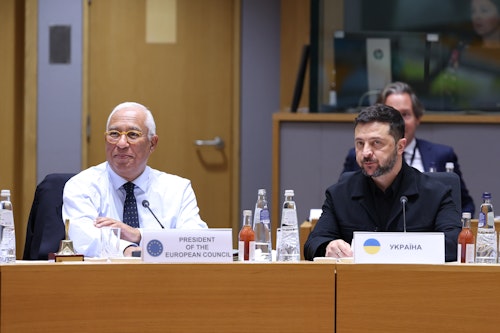
Ukraine was enjoying a high moment after yesterday’s decision by the US to increase, for the first time, sanctions against Russia. The country was hoping that EU leaders would endorse a groundbreaking plan to issue a €140 billion reparations loan based on Russia’s immobilised assets, the bulk of which is held in Belgium.
After attending the summit, President Volodymyr Zelenskyy urged leaders to take the step.
“Money we need it in 2026 and better to have it at (the) very beginning of the year,” he said.
“I don’t know if it’s possible, not everything depends on us,” he added. “We understand who can block and we can work with these people,” he said, seemingly referring to Belgium.

In the end, Belgian Prime Minister Bart De Wever appeared to hold his ground.
Going into the meeting, De Wever had listed three demands in exchange for his blessing:
- The “full mutualisation” of risks, including legal claims filed by Russia.
- Guarantees to ensure that, if the assets are unfrozen and the money has to be paid back, “every member state will have to chip in”.
- An obligation for all European countries that hold Russia’s sovereign assets to participate.
“If we move, we must move all together, that’s European solidarity,” he said. “If these three demands, which are quite reasonable, I think, are met, then we can go forward. If not, I will do everything in my power at the European level and also at the national level, politically and legally, to stop this decision.”
During the day, new drafts were circulated with expanded language on burden-sharing, collective solidarity, respect for international law and G7 coordination. But it seems the overture failed to convince De Wever, who, perhaps deliberately, had raised a high threshold for his fellow heads of government.
The final language agreed by leaders is considerably weaker, speaking ambiguously about exploring “options” to meet Ukraine’s military and financial needs for the next two years.
The frozen assets are mentioned but are not linked to the assistance itself. “Subject to EU law, Russia’s assets should remain immobilised until Russia ceases its war of aggression against Ukraine and compensates it for the damage caused by its war,” the text only reads.