




 Ed Habershon / BBC
Regular power cuts had become a feature of South African life and fed feelings the country was moving in the wrong direction, but the electricity supply has been uninterrupted since March leaving people to wonder what has changed.


It is a crisp winter’s day in Johannesburg, a clear blue sky shimmering over the bustling township of Alexandra, or Alex, as it is more commonly known here in South Africa.
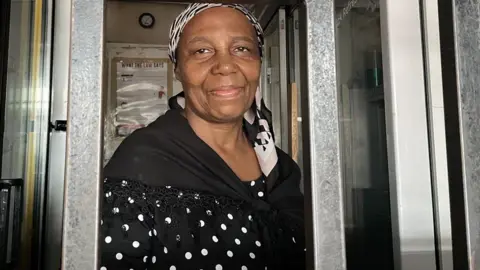
Sizeka Rashamosa is standing in her restaurant, a stream of people swirling around her, some delivering crates of beer, another grilling meat on a hotplate. A group of young men are sitting at a sun-drenched table.

“I can’t talk,” she says, “I’m busy.”
It is a far cry from when we first met in March last year, at the height of South Africa’s power crisis and frequent load-shedding, the official term for scheduled power cuts.
Back then Ms Rashamosa had very little electricity, and just one customer. A reflection of the wider impact on the economy.
“The power is everything,” she said at the time. “I’m very stressed. We don’t have money because of the electricity, you can see it’s dark. I don’t think I’ll survive in my business. We’ll have to close down after 25 years. It’s terrible.”
But now, when she finally finds a few minutes to talk, things are more positive.
“The load-shedding is much better now,” she says. “You can see, there’s electricity. And now I’m busy. I’m going to stay open, no plans to close, not anymore.”
It is a remarkable turnaround.
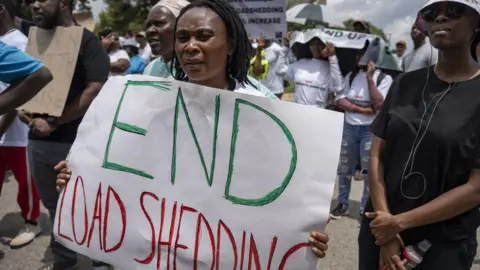
Load-shedding began in 2007, reaching a low last year with power cuts often lasting more than half a day.
This year it was expected to get worse. But now there has been no load-shedding for more than four months – since 05:00 on 26 March to be precise – the longest break in more than four years.
 Getty Images
How has the turnaround happened, and will power cuts return?
It is largely because of a set of programmes from the state-owned power provider Eskom and the government over the last two years.
In July 2022 President Cyril Ramaphosa announced the Energy Action Plan, and the following February he declared a national state of disaster over the electricity crisis.
Soon after he created the role of electricity minister, appointing Kgosientsho Ramokgopa.
And then Eskom launched the two-year Generation Operational Recovery Plan, the key aim of which was to increase the amount of power – known as the “Energy Availability Factor” (EAF) – to 70% of the network’s potential.
At the same time Eskom overhauled its leadership, which most point to as a crucial factor.
For years the company had been beset by corruption under former President Jacob Zuma, known as “state capture”, when it fell victim to acts of theft and sabotage. A former CEO even claimed to be have been poisoned.
“If you look at them now, it’s a good mix. You have technical people, you have financial people, you have people with skills in turn around,” says energy analyst Ruse Moleshe.
“Our 40,000 employees that we have are more committed, more motivated, because load-shedding really was discouraging all of us, morale was very low,” says Daphne Mokwena, Eskom’s national spokesperson.
 Getty Images
Another significant move last year was a 254bn rand ($14bn; £10.9bn) debt-relief package from the treasury to plug Eskom’s financial blackhole.
As a result there has been a substantial reduction in unplanned outages at Eskom’s power stations, that had been caused by break downs in units.
This in turn meant that a programme of planned maintenance could be carried out.
That has led to more energy capacity, and on 23 July it reached 35,000 MW, its highest in six years.
“There’s been a pipeline of these large projects,” says energy expert Chris Yelland, referring to the plans that had been put in place since July 2022.
“It’s like having a pipe where you stuff marbles in one end, and you keep on stuffing them in because it takes a long time, and eventually the marbles start popping out.”
Then there are the external factors.
“The first thing one can say is that the total demand for electricity [from Eskom] by the South African economy as a country has been reducing, for a decade,” says Mr Yelland.
This is down to two factors – the increasing energy bills and the spread of alternative energy sources.
“Every year we have an electricity price increase from Eskom at several times the inflation rate so the real price of electricity is going up and has been doing so for years,” says Mr Yelland.
“And there has been a remarkable increase in solar and battery energy storage systems across the board from individual residential applications, to commercial, industrial mining and agricultural.”
Sluggish economic growth has also led to less upward pressure on the demand for power.
Minister Ramokgopa holds frequent media briefings in the capital, Pretoria, by far the most in South Africa’s government, and regularly visits Eskom’s power stations.
He was typically upbeat in his latest briefing, particularly proud of the fact so much was being achieved in winter, the time of year that sees the most demand on power.
But could all of this have happened much sooner?
“I think we could have managed this situation better when we were told much earlier ‘you’re going to run out of capacity, invest in new generation capacity’,” Mr Ramokgopa told the BBC.
“We thought the market will resolve that problem, when in fact the state must lead, and we didn’t create conditions for the market to respond appropriately.”
He also admits that load-shedding played a role in the disastrous election result in May for the African National Congress (ANC) when it saw its vote share fall below 50% for the first time.
“Our core base was not convinced that the administration is capable and willing to resolve the problem. We have paid the penalty, we are here, government of national unity are committed to that and to resolve the South African problem. I’m confident that we’ll get it right.”
As a result of the changes is load-shedding now a thing of the past?
“It is too soon to claim victory,” said President Ramaphosa in an address last month.
“Our electricity system is still vulnerable and we cannot yet rule out – yes – possible challenges going forward.”
There is still the occasional power cut – what is known as “load reduction” – whereby Eskom switches off power in high-usage areas to prevent damage to local infrastructure, like transformers, which would in turn lead to more lengthy power cuts.
Eskom mainly attributes this to illegal connections and overcrowding of properties – what it and the government refer to as “backyard dwellers”.
The government says 5% of South African households are affected by load reduction.
But things seem genuinely positive.
“We’re not out of the woods yet, but the probability of us going back to load-shedding is very slim if we keep doing what we are doing currently”, says Daphne Mokwena.
Back in Alex, Ms Rashamosa is preparing for a busy weekend, one she could not have imagined this time last year.
“Life is much better now,” she says, then darts off into the back of her restaurant.
You may also be interested in
 Getty Images/BBC


