




 Thuthuka Zondi / BBC
A biodiversity hotspot in a remote part of South Africa has become the hub of an illegal trade in protected plant species, with organised crime groups capitalising on overseas demand.
“They’ve not just stolen our land or our plants, they’ve stolen our heritage as well,” a livestock farmer angrily tells the BBC, as she expresses dismay at the social and ecological crisis that the poaching has caused.
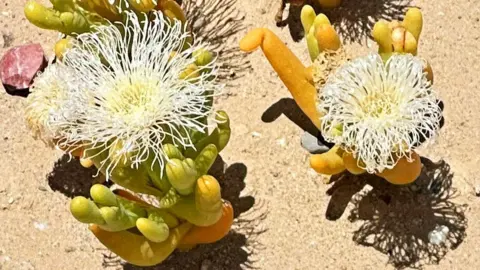
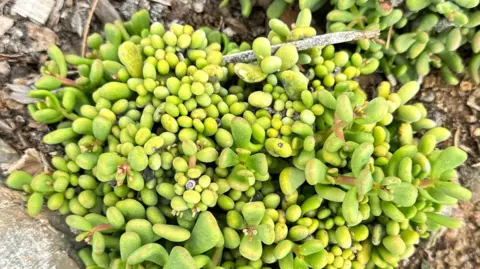
Most of the plants in question are a variety known as succulents, named for their ability to hold water and survive in arid climates.
Many of the world’s succulent species are only found in the Succulent Karoo desert, which spans South Africa and Namibia.

Succulent species range in size, shape and colour – some look like small multi-coloured buttons and some look like cacti, sprouting colourful flowers at certain times of the year.
While these varieties can be cultivated in nurseries, global demand is also fuelling the poaching of these plants from the wild which are then smuggled and sold online to buyers in the US, Europe and East Asia.
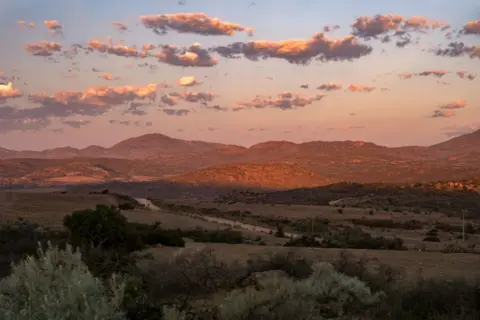
In Kamieskroon, a small town in the centre of South Africa’s Namaqualand region, the rolling hills have become a haven for poachers.
Some of the species are highly localised, and so can be wiped out by just a small amount of poaching.
“In South Africa, we know already of seven species that has been wiped out completely and there are certainly more species that will go extinct very soon,” says Pieter van Wyk, a nursery curator at the /Ai /Ais-Richtersveld Transfrontier Park.
It is hard to obtain figures for how many plants are being poached, but the non-governmental organisation Traffic reports that 1.6 million illegally harvested succulents were seized by South Africa’s law enforcement agencies between 2019 and 2024. This only represents the contraband that was detected, so the true figure is likely to be far higher.
The South African government is well aware of the problem, and unveiled a strategy in 2022 to combat poaching. It includes running community programmes about the need to protect the environment.

 Getty Images
 According to Mr Van Wyk and other conservationists, plant poaching has been booming since the Covid-19 lockdown in 2020.
With international traders unable to travel to South Africa during that time, they turned to local people to collect succulents for them and post them out of the country.
Mr Van Wyk says this coincided with an increase in global demand.
“People had more time to try to find something to keep busy with, and plants were one of the only things that in your house, could connect you to the outside world.”
This has been seized upon by organised crime syndicates who hire teams of plant poachers and then market the wild plants on social media and e-commerce platforms.
“The syndicates saw this as an opportunity of making something viral… telling a wide as possible public: ‘We have this super-strange looking thing that comes from the African continent’,'” Mr Van Wyk says.
“Then the public just loses their heads and they say: ‘I want to buy one’, and [the syndicates] arrange for the species to be poached,” he adds.
The uptick in organised crime activity in the region is having knock-on effects on local communities.
“This is a low-income area, people are not rich here, and people will exploit opportunities for income,” explains Malinda Gardiner from Conservation South Africa.
Expressing a similar view, the livestock farmer whom the BBC spoke to says there is always an influx of money in her community when poaching takes place.
“When we see young men going up in the mountain areas, we know they’re poachers,” adds the farmer, who asks not to be identified for fear of reprisals.
“They use screwdrivers to uproot the succulents and they carry backpacks and sacks to keep the stolen plants.”
 Thuthuka Zondi / BBC
A few days after that, there is an outbreak of binge drinking and illegal activity.
“When they get the money, there’s more drugs, more alcohol, children are neglected because mummy is drunk, daddy is drunk, there’s no food,” adds Ms Gardiner.
She worries that the tensions will have longer-term effects.
“Small communities here really need each other… but this brings distrust. It brings a split in the communities as well,” she says.
Mr Van Wyk’s assessment is starker: “People are being abused and enslaved by syndicates and buyers.”
Attempts are being made to raise awareness among buyers about the importance of understanding where a plant might have come from.
China has become a major source of demand for wild succulents in the last few years, but an internet campaign there to educate people about the illegal succulent trade has seen some results.
The Clean Internet for Conophytum campaign was launched in March 2023 by the China Biodiversity Conservation and Green Development Foundation.
According to the foundation’s deputy secretary-general Linda Wong, they have seen an 80% reduction in online adverts for conophytum – a type of succulent – with an unknown source, and buyers are starting to ask questions about where plants being sold online have come from.
“The key is awareness. Once people know, they want to take action. They want to take responsibility to consume those plants and enjoy their beauty in a very responsible way,” she tells the BBC.
Conservationists advise customers all over the world to ask about the origin of a plant, and under no circumstances should they buy those advertised as wild.
Traffic and the UK’s Kew Gardens recently announced that they were teaming up with eBay to develop new ways of preventing the sale of wild succulents on its platform.
In South Africa, Mr Van Wyk says more should be done to promote the cultivation of succulents that can be grown and harvested legally, to reduce the demand for poaching.
“We as a country need to say that: ‘We have this resource, and there are other countries that are majorly benefiting from this, why aren’t we?'” he tells the BBC.
Mr Van Wyk now runs a nursery at the /Ai /Ais-Richtersveld Transfrontier Park which looks after plants that have been confiscated by law enforcement, and he says they have received more than 200,000 so far.
“It’s obviously stressful seeing things disappearing. But if you study these plants, it brings so much joy and pleasure and you just forget about all the nonsense that’s happening in the world,” Mr Van Wyk says.
More BBC stories on South Africa:
 Getty Images/BBC


