




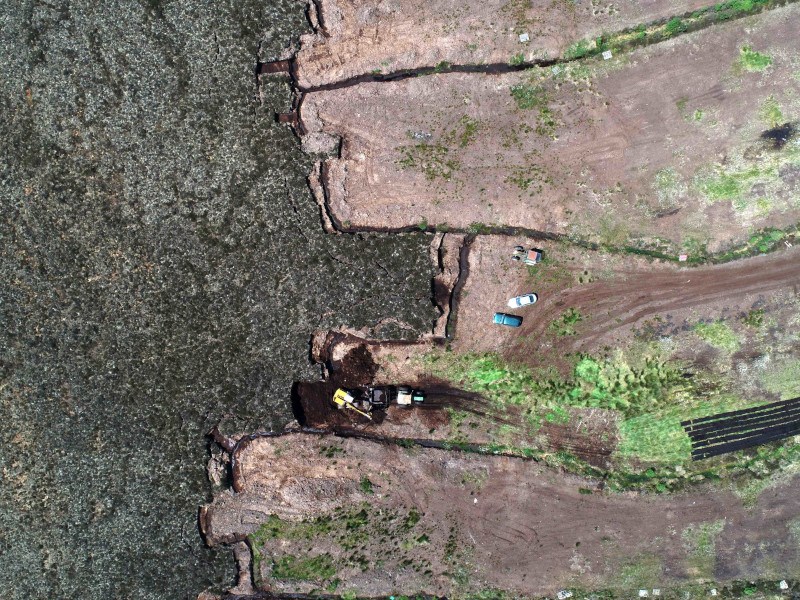
AI2Peat lead Dr Corrado Grappiolo tells SiliconRepublic.com that he wants government agencies to use their data for effective policymaking.
An AI-powered peatland monitoring platform and an EV battery innovation project are the first to receive prize funding under the National Challenge Fund, sharing a grant of €2.5m.
The €65m challenge was launched in 2022 with the aim of driving innovation in green transition and digital transformation. Funding for the challenge is divided into sections, and began with 96 teams that received €50,000 each for their initial concepts.

Each succeeding phase has whittled down the winning teams, with only a few receiving grants in the prize phase which are worth more than €1m.
The ‘A12Peat’ project led by Dr Corrado Grappiolo from University College Dublin uses satellite imagery, data from the National Parks and Wildlife Service (NPWS) and machine learning models to monitor peatland conditions in Ireland to provide insights to support national peatland restoration efforts.
Peat bogs are a vital carbon sink, which, when healthy, help protect against flooding. Dr Grappiolo’s project received its prize grant of €1m under the Future Digital Challenge.
“AI2Peat has collaboration at its core, and our achievements would never have been possible without the expertise and guidance of the [NPWS] and the 200-plus stakeholders we have been interacting with,” said Grappiolo.
Speaking to SiliconRepublic.com, Grappiolo said that the next step is to scale up the A12Peat project. “Specifically, we want to expand our machinery capabilities to map the ecology of peatlands.
“[And] we want to go beyond that – go towards land cover mapping, bare peat detection –because that’s really fundamental.”
The AI2Peat team’s platform ‘Peatsense’ is freely available online and details peatland conditions all across Ireland. Grappiolo hopes that government agencies engage with the information they’ve collected for effective climate policymaking.
“We are already engaging with these agencies. We keep showing the capabilities and the potential of our platform and we hope it will be adopted as soon as possible,” he added.
Meanwhile, the winning project under the 2050 Challenge is ‘Drive’, which aims to mitigate the heat emitted from cells in a battery pack. The team’s improved thermal management increases the performance and lifespan of lithium-ion batteries in electric vehicles (EVs), as well as making them safer.
Drive lead Dr Seamus O’Shaughnessy from Trinity College Dublin explains that their next plan is to scale up their prototype. “So essentially we’re trying to industrialise our solution”, he said. The project has received €1m in prize funding.
O’Shaughnessy explains that scaling the solution for the industry means making as little change as possible to the existing battery packs in EVs, as the tech would not be adopted if the battery increased in weight, cost or the materials used.
“The support from Research Ireland over the next two years will enable us to further develop and industrialise our novel lithium-ion battery thermal management solution to meet the needs of current and next-generation battery applications, in particular [EVs].”
Making the announcement today (17 September), Minister for Further and Higher Education, Research, Innovation and Science of Ireland James Lawless, TD said the winning teams are “working on innovative, solutions-focused projects that will help to deliver transformational societal and economic impact and support Ireland’s progress towards becoming a climate-neutral economy by 2050”.
Don’t miss out on the knowledge you need to succeed. Sign up for the Daily Brief, Silicon Republic’s digest of need-to-know sci-tech news.


