




For console players, Microsoft Flight Simulator was something to be admired instead of deciphered, a technical curio for hardcore simmers. Then, after 2021’s arrival on Xbox, the series’ first voyage beyond PC – its broader, more casual potential emerged. Now, 12-months after 2024 took flight, MSFS is diverting to Sony’s airspace, introducing its meticulous demands to a new school of aspiring aviators on PS5.
But look, despite Xbox establishing the shift to couch aeronautics, Microsoft Flight Simulator on PlayStation still feels unusual. It’s a living, breathing simulation built for flightsticks and multi-monitor rigs, not sofas and TVs. So, as I taxied toward my first take-off, DualSense in hand, questions hung in the air: can the feel of flight genuinely translate through a television? Will a controller give any real sense of being airborne? Might my living room, even briefly, pass as a cockpit?
“Starting your career, you’ll choose which of the game’s regional airports to use as headquarters.”

I admit, at first it felt too novel. Then, lifting off with the ground shrinking beneath me, MSFS’s methodical simulation became unexpectedly transformative. I realised that its casual appeal is not in reading navigation charts or understanding what each switch and gizmo does, it’s in staring at the world beneath you.
Starting your career, you’ll choose which of the game’s regional airports to use as headquarters. I chose an airfield near Gotemba, Japan, in the shadow of Mt. Fuji, figuring the iconic mountain will make an impressive backdrop. Once missions became available, I was directed to Tokyo to shuttle flightseeing passengers over the surrounding scenery. An optional flight plan crossed over Koganei, and I chose it immediately. See, my friend lives there, I don’t know which house, nor have I visited, but it was a sense of wondering which drew me in.
Soaring overhead, I hoped this transcendence would encourage me to study the cockpit, the function of its switches still a mystery. Back at base, awaiting were copious certifications which, as a casual pilot, I initially found overwhelming.
Yet, you don’t make it to Top Gun by flying as a maverick, so I hunker down for more training. MSFS 2024 had already done a decent job of orienteering around the Cessna 172 Skyhawk, walking me through the starter plane’s pre-flight checks, and teaching me the fundamentals – airspeed management, executing pitch, rolling, following traffic patterns, and more. Even before my trip over Koganai, I could already take-off and land with conviction.
“Once I became proficient enough to keep the aircraft consistently stable and on-route, the sky opened up.”
Passing the next certification ensures I now get paid for ferrying passengers, with lessons covering trim adjustment, a system enabling stable altitude without constant thumbstick pressure – engine RPM monitoring, and landmark navigation.
By this point I’d already noticed a handful of gameplay imperfections, which I’ll leave in holding pattern for now, but during these lessons I found engaging the engine RPM unintuitive. I pinpointed missing HUD info as the origin of my stagnation. See, beyond the cockpit’s diegetic display, the default on-screen HUD’s icons – detailing airspeed, fuel load, altitude, et cetera – don’t include RPM. To correctly follow my instructor’s command of maintaining 1,700 RPM, I zeroed-in on the top-left corner of my cockpit’s display. The number is too small to read from the sofa without switching camera view, steepening my learning curve while highlighting an accessibility oversight.
I abandoned my gaze on the horizon to check the throttle lever, instantly faltering my altitude. So, as a workaround, I started listening to the engine, developing intuition, perhaps; but almost-certainly against the game’s intention. And, a deeper problem: I could only hear the engine at top revs – an issue I’ll get to later.
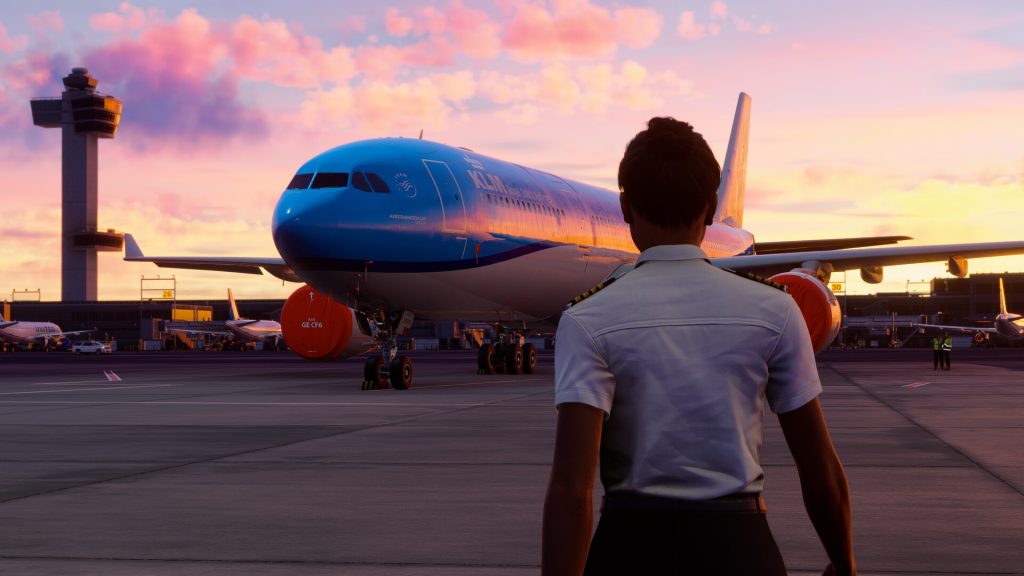
Yet, despite this, I reached a critical turning point. Once I became proficient enough to keep the aircraft consistently stable and on-route, the sky opened up. Cruising over the Arizonian expanse became meditative; I was now able to absorb the game’s gorgeous scenery and lighting. Rolling my Cessna toward Sedona, sunset cascaded through the cockpit with canyons below decorated by sparkling lens flares.
Later activities saw me passing over German forests as needlesharp rain beat the Cessna’s wind-shield. I streamed over the Great Barrier Reef’s azure blue, hovered beside the Pyramids during golden hour, and searched for wolves at daybreak over Northern Spain – each excursion visually engrossing. Now the shaky flying of my early career is behind me, the game’s promise of flying anywhere became a tangible, transportive reality.
To answer the first of those earlier questions, can the feel of flight genuinely translate through a TV? – I’d say it can. Visually, the game looks remarkably accomplished given it is drawing detail from the cloud, though frequent texture pop-in and distant low-resolution curtail its implementation. It can take a while to get to the point where you’re navigating calmly, long loading times on the base PS5 notwithstanding. But once you’re cruising, Microsoft Flight Simulator 2024 captivates beyond the code of its simulation.
Now, to answer the next question. Can the DualSense give tangible airborne feeling? I’ll need to go over those imperfections alluded to earlier.
“3D audio exists but isn’t deeply implemented. Worse, headphones expose an uneven sound mix that’s not as perceptible through TV speakers.”
I’ve never flown a plane in real-life, but I imagine the nuance required to maintain smooth transit replicates well in MSFS 2024. It’s all thumbstick micro-adjustments and tentative trigger presses; being cautious not to over-correct a wayward trajectory, rolling at 20 degree precision, gently adapting RPM, carefully adjusting trim percentage – as a player now chasing piloting perfection, managing these systems became as crucial to my engagement as scanning the scenery. Yet, the game’s failure to fully embrace the DualSense’s sensory potential leaves my pursuit of flawless flying feeling oddly disjointed
Haptic feedback does give runway tarmac a tactile feel, which is more noticeable if you accidentally veer off the strip onto gravel or grass. Yet, its complete non-existence in-flight, save for subtle flap or landing gear clunks, is jarring. Rudder resistance is felt through the triggers, but its application is limited in scope. You don’t use them much unless your plane naturally sways left or right. Helicopters use the triggers to steer, but their resistance is lighter.
Better implemented are ATC instructions which cut through the DualSense’s on-board speakers, while cockpit warnings flash through the light-ribbon. 3D audio exists but isn’t deeply implemented. Worse, headphones expose an uneven sound mix that’s not as perceptible through TV speakers.
During cruising speed, the engine’s hum becomes a whisper, while robotic passengers perforate my eardrums with their non-plussed musings. Sound levels can be tweaked, of course, but there’re no adjustments which encourage more audible engine noise. Combined with inert haptics, the sensory rush of flight never truly materialises. Whether gliding through clement airstreams or wrestling with turbulence, tactile reactions don’t emerge. MSFS 24 is a simulation which nails the visuals, but forgets the visceral.
You could argue that a controller isn’t the “correct” way to fly. Perhaps the tactility missing in the DualSense will be felt through a peripheral flightstick. Now, the only peripheral currently supported on PlayStation is the Thrustmaster T.Flight HOTAS 4, and despite its modest pricepoint, I’m going to guess that most PS5 players don’t own one. So, MSFS 2024 on PS5 must do more to embrace DualSense’s immersive potential. The experience isn’t killed outright, but its underutilisation undersells the overall experience.
I’ve noticed a handful of other bugs too: my aircraft spawned 3ft above ground, crashing before the instructor finished her briefing; dark shadows surrounded my avatar during a snowy photoshoot; ATC operatives talked over each other, delivering a vocal mashup impossible to decode; a game-ending crash halted my first-ever mission. The most confidence shattering was a black screen appearing mid-way through my first flight, pitch dark for a minute before resuming. I’m unsure if this was by design, but it lingered on my mind.

“During cruising speed, the engine’s hum becomes a whisper, while robotic passengers perforate my eardrums with their non-plussed musings.”
Yet, as broad as these irritations are, they’re infrequent enough not to be deal-breakers. On PS5, Microsoft Flight Simulator 2024 is imperfect, occasionally obtuse, and sometimes rough around the edges. It’s also the closest PlayStation players have ever come to the real sensation of flight. Did my living room transform into a metaphorical cockpit? Partially, DualSense’s underwhelming implementation can’t replicate a HOTAS setup, with some readability issues genuinely holding back the experience. Yet, the world, the weather system, and the slowly blossoming sense of mastery make MSFS 2024 utterly absorbing.
It’s more than a technical curio now. Microsoft Flight Simulator 2024 on PS5 is a journey, one that nudges you persistently, whether you’re casual or veteran, toward your own piloting zenith.
This game was reviewed on the PlayStation 5.


