




WASHINGTON—The Supreme Court’s decision to strike down the Chevron deference, which had the effect of enhancing federal agency power, has been deemed a “seismic” change for U.S. administrative law.
Members of Congress tell The Epoch Times that they believe the Supreme Court ruling will equally shake up the process of lawmaking.
Chief Justice John Roberts wrote that the Loper Bright decision now empowers courts to “independently interpret the statute and effectuate the will of Congress.”
Members of Congress have since been considering how to update the way that laws and regulations are drafted to meet the requirements outlined by the Loper Bright decision, such that the “will of Congress” may be clear when regulations are challenged in court.

Specify Laws
Lawmakers on Capitol Hill indicated that several reforms to the legislative process are likely to follow the Loper Bright decision.
“This institution is going to have to change; how we staff committees is going to have to change, and how we work with the administrative state will have to change,” Rep. Patrick McHenry (R-N.C.), chairman of the House Financial Services Committee, told The Epoch Times.
“We’re going to have to be much more specific in the lawmaking exercise … we’re going to have to have committees that have more staff in order to accommodate specific legislative writing.”
He said Congress will “have to have some changes in our internal processes of what comes to the floor.”
“We don’t have the muscle memory of how to write laws specific enough … it’s muscle memory that has to be recreated here. And it’s possible but it’s going to be hard,” Mr. McHenry said. He briefly acted as the House Speaker pro tempore in 2023 after Rep. Kevin McCarthy (R-Calif.) was stripped of the gavel.
The Supreme Court in Loper Bright opined that non-specificity in statutes is unintentional, suggesting that Congress could now intentionally write laws more specifically.
“A statutory ambiguity does not necessarily reflect a congressional intent that an agency, as opposed to a court, resolve the resulting interpretive question. Many or perhaps most statutory ambiguities may be unintentional,” Justice Roberts wrote for the court’s majority opinion.
However, members of Congress say ambiguous laws are a political necessity, given disagreements between lawmakers over a law’s scope and purpose.
In those situations, Congress, for convenience, often delegated the interpretation of some laws to federal agencies, which gave them wide discretion to regulate.
“The vast majority of all regulations in the last 40 years have been because of the ambiguity,” Sen. Rand Paul (R-Ky.) told The Epoch Times.
“When people know there are not votes to pass the laws, they figure: ‘Well, let’s make it ambiguous, and then the agency will interpret it in a way we like,’” Sen. John Cornyn (R-Texas) told The Epoch Times. “None of that will be able to occur anymore.”
“The Supreme Court seems to be pointing at Congress to say: Be more specific,” Sen. Tim Kaine (D-Va.) told The Epoch Times. “That does put a little more of a burden on our shoulders when we’re doing legislation, to not just broadly defer. Exactly how specific [laws] have to be, I don’t know.”
That level of specificity has divided members as they draft legislation, with some believing it’s impossible.
“There is always going to be some ambiguity in the bills that we pass … as much as you want to write bills that are very, very specific, you can’t,” Rep. Carlos Giménez (R-Fla.) said.
Instead, some lawmakers believe Congress should now specify how courts treat post-Chevron disputes about regulations, such as making evidence reviewable “de novo”—whereby courts can examine evidence beyond the agency’s administrative record, to which they are currently limited by the Administrative Procedures Act (APA).
That proposal goes beyond Loper Bright, in that courts would not only interpret the law authorizing a regulation but also judge the validity of scientific and technical evidence supporting it.
“Moving forward, we need to prescribe and be very clear that … [there] is a de novo review,” Sen. Eric Schmitt (R-Mo.) told The Epoch Times.
Others think that all new regulations should require Congressional approval before passage.
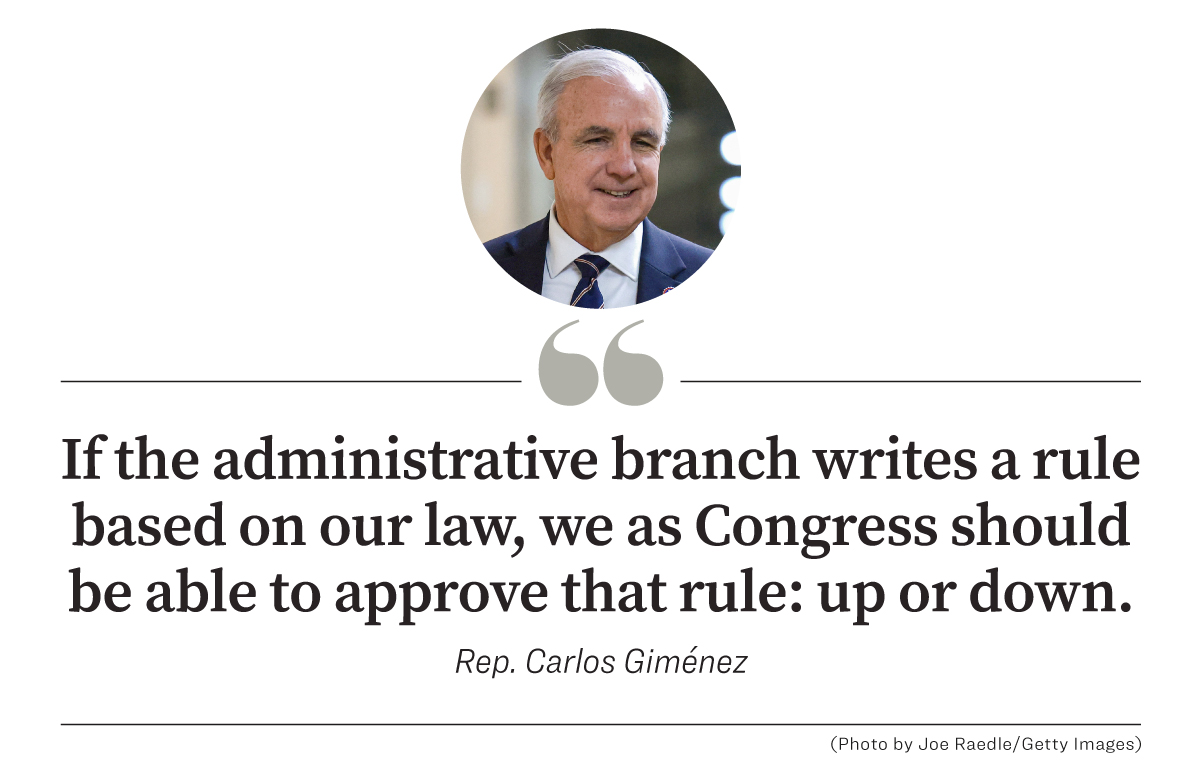
“Rulemaking should come back to the House. If the administrative branch writes a rule based on our law, we as Congress should be able to approve that rule: up or down,” Mr. Giménez said.
Some Lawmakers Favor Reversing Loper Bright
As some members of Congress consider how to adapt to Chevron’s departure, several Democrat lawmakers have responded by looking for ways to restore Chevron deference to agencies.
“We’re going to fix what the Supreme Court did when they overruled precedent for no good reason, in what is known as Chevron case,” House Democratic Caucus Vice Chair Ted Lieu (D-Calif.) said.
“The Supreme Court has now essentially said that, ‘Hey, judges are better than the technical experts at agencies and looking at congressional statutes’ … No, judges are not better,” he said.
Efforts to codify Chevron deference into law have been gaining steam among congressional Democrats.
The Senate’s 60-vote “cloture” requirement to overcome a filibuster means such reforms are unlikely unless Democrats force a rule change to rescind it. Moreover, some legal experts raise constitutional and practical concerns about the idea.
“Over the years, Chevron had acquired many exceptions, qualifications, and acknowledged ambiguities,” said Jeremy Rabkin, a distinguished fellow at the C. Boyden Gray Center for the Study of the Administrative State.
“It wouldn’t be enough for a statute to say, ‘Never mind Loper Bright, just go back to Chevron.’ The statute would have to explain what that was supposed to mean. But, once you get down to the details, I am doubtful Congress could reach an agreement on what it would like,” Mr. Rabkin said.
“Beyond all that, I think there are serious constitutional problems with a statute that tells courts how they should interpret statutes.”
Other Democrats have suggested more measured reforms.
“We’re still looking into [reforms] and whether a general amendment of some kind to the Administrative Procedures Act, or more specific bill by bill ramparts, to protect the expertise from judicial meddling are the best way to go,” Sen. Sheldon Whitehouse (D-R.I.), the chairman of the Senate Budget Committee, told The Epoch Times.
Since the Loper Bright decision, Congress has not taken up any major administrative proposals that would invite regulation.
Whenever that may be, it will likely prove to be the first test of how Congress proceeds with legislation post-Chevron.
“There’s been a sea change of how this place operates. I think, how the whole government operates,” Rep. Dean Phillips (D-Minn.) said of the impact of the decision.


