




25 years ago, EA released its first-ever M-rated game. Rather than take a risk on an established, mainstream franchise at a time when games still had to be purchased physically — and often by parents who would be put off by an M rating — EA tested the waters with American McGee’s Alice: an off-the-wall third-person fantasy game that put a dark spin on Lewis Carroll’s classic children’s tale.
The end result was an edgy, weird, and unforgettable experience. At EA’s insistence, American McGee’s Alice earned its title from designer and game director American McGee — known for his work on id Software’s Doom and Quake series — in the hopes of distancing itself from Disney’s kid-friendly take on Alice’s Adventures in Wonderland. Ads for the game showed Alice slashing away at enemies with her Vorpal Blade, something the game received significant criticism for — even from game journalists — before it was even released.
“Parents, take heed, this is not a game you should buy for your children,” McGee said during one post-launch interview. “I felt that if we had been tame with our marketing materials, we might have sent the wrong message to parents.”


In American McGee’s Alice, the titular character is experiencing Wonderland not through the imaginative, innocent eyes of a child, but through the mind of a traumatized young woman suffering from hallucinations due to mental illness. Alice’s parents and sister have died in a house fire, leaving young Alice to fend for herself. The loss of her family combined with the guilt she feels for being unable to save them results in a twisted version of Wonderland that has been corrupted by trauma and mental distress.
Alice has spent the years since the fire residing in a mental hospital, where she’s been receiving questionable treatments from medical professionals who do not seem to care much for her wellbeing (the game is set in 1863 London, so this isn’t exactly shocking). Eventually, she retreats into her own inner world, which is when she discovers how different (and dangerous) the Wonderland she once knew has become. As Alice, players must navigate their way through this nefarious version of wonderland, taking on enemies in combat, solving puzzles, and jumping through platforming sections to complete each level.
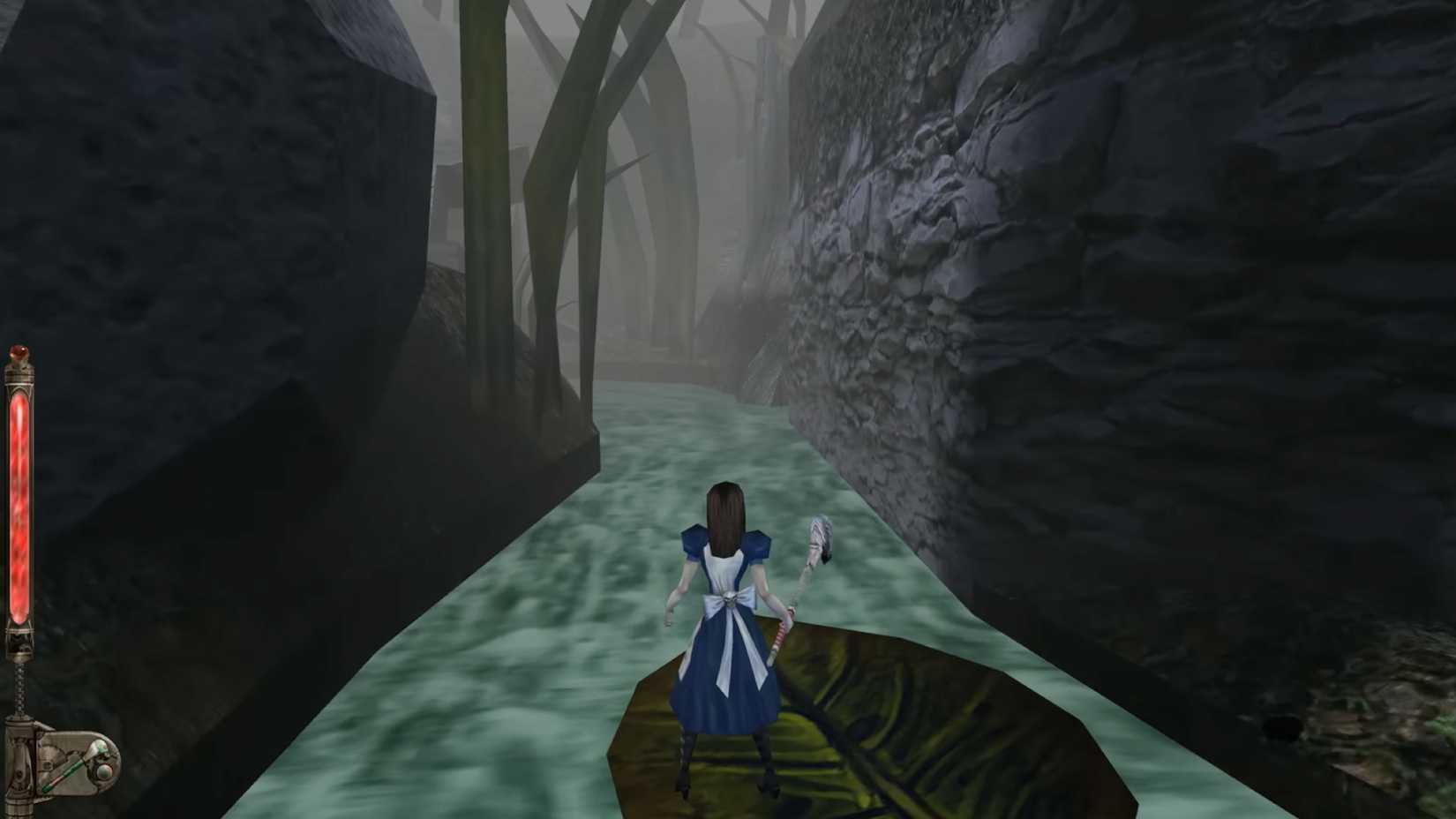
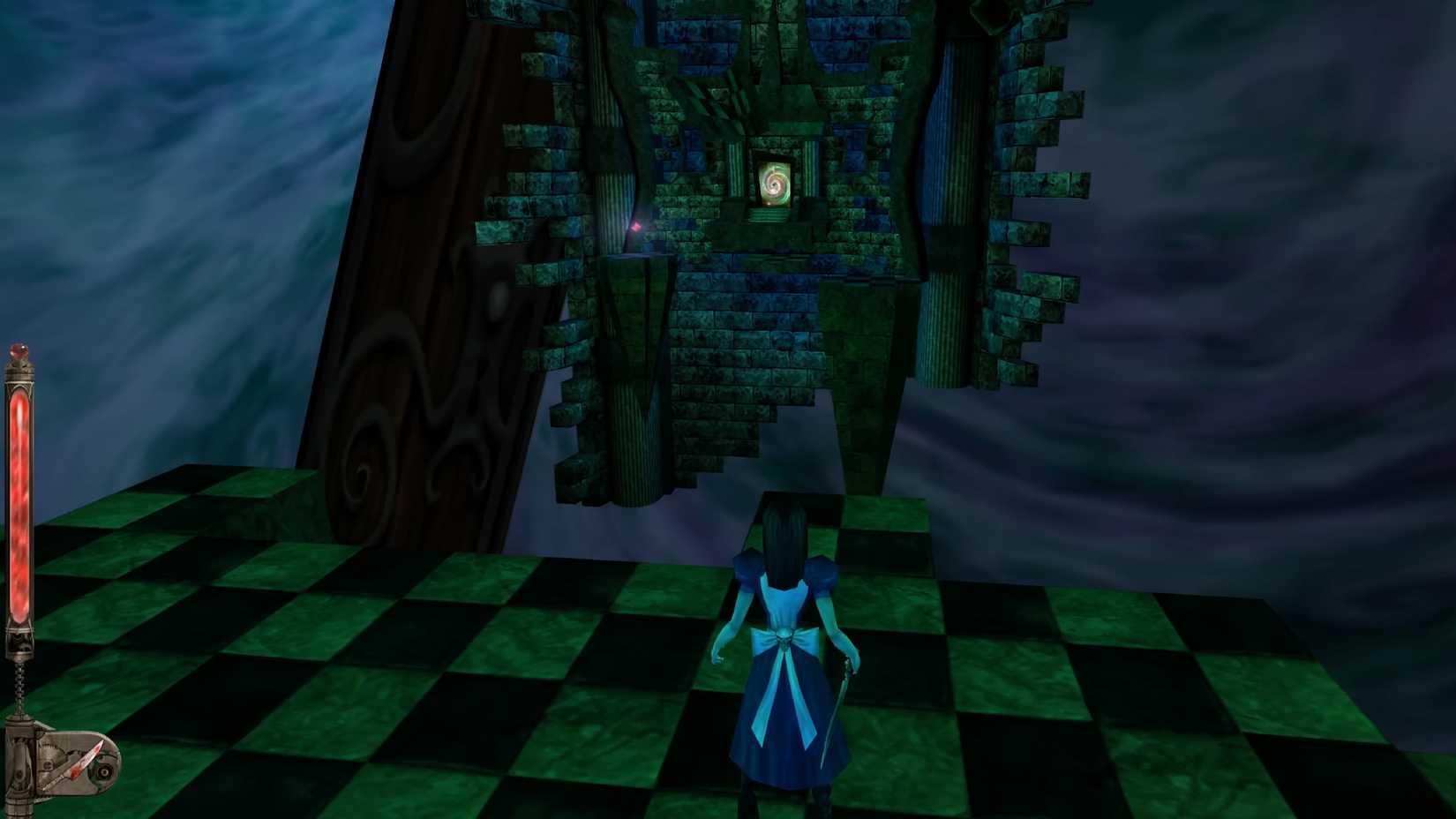
The game’s auto-targeting mechanic and lack of awful tank controls made combat feel significantly smoother than many other games from the same era (looking at you, Silent Hill). But Alice‘s visuals and soundtrack were what made it really stand out. It wasn’t a horror game, exactly — “dark fantasy” is probably a more apt genre description — but it was certainly creepy. The game’s cover art features Alice in her usual blue dress and white apron, but she’s tightly gripping a knife, and her apron is splattered with blood. At her side, an emaciated, tattooed version of the Cheshire Cat grins menacingly. Every character — from the Mad Hatter to the Red Queen — was designed by American McGee, giving them a unique steampunk-fairytale aesthetic. Alice‘s environments, too, were both beautiful and bizarre, with some rooms having a solid floor to walk on, but an endless void of swirling colors where there should be walls.
Chris Vrenna — who served as Nine Inch Nails’ drummer from 1988 to 1996 — was tapped to create the game’s original soundtrack, and his dreamy-yet-industrial OST remains one of my all-time favorite game soundtracks to this day. Vrenna’s nursery-rhyme-meets-industrial-rock musical score, combined with the game’s unsettlingly trippy aesthetic makes for an experience that’s unlike any other — which is exactly what McGee wanted. After leaving id Software in 1997, he was hoping to create a game that didn’t involve guns, outer space, or aliens. After only 18 months of development, Alice was born.
The game was generally well-reviewed and currently sits at an 85 Metascore, which was enough to get its 2011 sequel, Alice: Madness Returns, greenlit. Madness Returns didn’t perform quite as well with critics (its Metascore is currently sitting at 70, but its user score is 8.1, nearly identical to the original game’s 8.0 user score). Still, both games are largely regarded as cult classics, and American McGee successfully kickstarted a film adaptation, though it unfortunately fizzled out. Still, hopes were high for a third Alice game, which McGee tentatively titled Alice: Asylum.

Sadly, there will be no third Alice game. McGee outlined his pitch for a third and final entry in the series, which was rejected by EA in April 2023. EA, however, still owns the rights to the Alice IP, so McGee cannot make another game without the company’s permission. He has since parted ways with EA, and lived in China for several years, where he focused on toy-making and free-to-play games. He has since returned to the US, but he says his days with Alice are done for good, and he wants fans to “stop continually asking me questions to which I do not have answers” regarding the franchise.
“I was emotionally quite destroyed by the fact that our proposal was rejected,” McGee said in a video uploaded to his personal YouTube channel in October 2023. “Not only because we had invested so much into it as a community and as creators, but because I felt quite strongly it presented a vision for something that was not only achievable but would have been quite beautiful.”

While we will likely never see the Alice trilogy completed, the fact that the series was ever greenlit to begin with was a bit of a miracle in itself, and resulted in a beloved cult classic that is seemingly adored by everyone by its publisher. The real tragedy is that there’s currently no way to buy American McGee’s Alice. It’s not on Steam or other storefronts. So unless you own a physical copy (that hasn’t developed disc rot in the quarter-century since its release) or got the original game’s remaster as a part of the Madness Returns pre-order package, American McGee’s Alice is quickly heading toward “lost media” status.
Still, playable or not, American McGee’s Alice is a creative, engaging take on the dark fantasy genre that deserves to be remembered, and will always have a place in my heart, even though the trilogy is unlikely to ever be finished.


