




Although public focus tends to center on the presidential candidates, past VP face-offs have produced some noteworthy exchanges.
On Oct. 1, Sen. JD Vance (R-Ohio) and Minnesota Gov. Tim Walz will face off in the final debate of the 2024 presidential season.
Vice presidential debates are a relatively new phenomenon in American politics: the first took place in 1976—16 years after the first televised presidential debate.
Although public focus tends to center on the presidential candidates, past VP faceoffs have produced some noteworthy exchanges, including some still discussed today.

Here are five of the most memorable VP debates.
1984: First Woman in a VP Debate
The October 1984 vice presidential debate between Vice President George H.W. Bush and Rep. Geraldine Ferraro (D-N.Y.) was notable for being the first to feature a female candidate.
Going into the debate, Ferraro faced concerns related to her limited political experience—having served just three terms, or six years, in the House of Representatives—rather than her gender.
Addressing the criticism during the debate, Ferraro said, “I wasn’t born at the age of 43, when I entered Congress. I did have a life before that.”
While Ferraro acknowledged the historical significance of her candidacy, gender was mostly a non-issue during the debate: both she and Bush focused more on policy, qualifications, and experience, particularly in realms such as foreign policy.
She emphasized her policy disagreements with Bush throughout the debate, which included issues such as civil rights, affirmative action, the growing influence of the religious right at the time, and the Supreme Court.
Reagan and Bush were ultimately reelected with the largest number of electoral votes—525 to Mondale and Ferraro’s 13—in U.S. history.
1988: ‘You’re No Jack Kennedy’
Going into the 1988 VP debate between Sen. Lloyd Bentsen (D-Texas) and Sen. Dan Quayle (R-Ind.), substantial public discussion centered around Quayle’s comparative youth.
Quayle, 41 years old at the time, struggled to defuse that perception during the debate, culminating in his ill-fated comparison of himself to Kennedy.
Specifically, when asked about the perception that he was too young for the No. 2 job, Quayle replied that he had as much experience in Congress as John F. Kennedy when he ran for president.
In one of the most famous quips in vice presidential debate history, Bentsen replied, “Senator, I served with Jack Kennedy, I knew Jack Kennedy. Jack Kennedy was a friend of mine.
“Senator, you’re no Jack Kennedy.”
The remark is still referenced and studied today as a prime example of political rhetoric.
Though the line harmed Quayle’s image substantially, the GOP ticket ultimately won 40 states in another electoral landslide.
1992: ‘Who Am I? Why Am I Here?’
October 1992 saw the first, and to this point only, VP debate featuring more than two major candidates.
Namely, the debate included Republican Vice President Dan Quayle, Sen. Al Gore (D-Tenn.), and celebrated Vietnam veteran Adm. James Stockdale, an independent running with billionaire and political outsider Ross Perot.
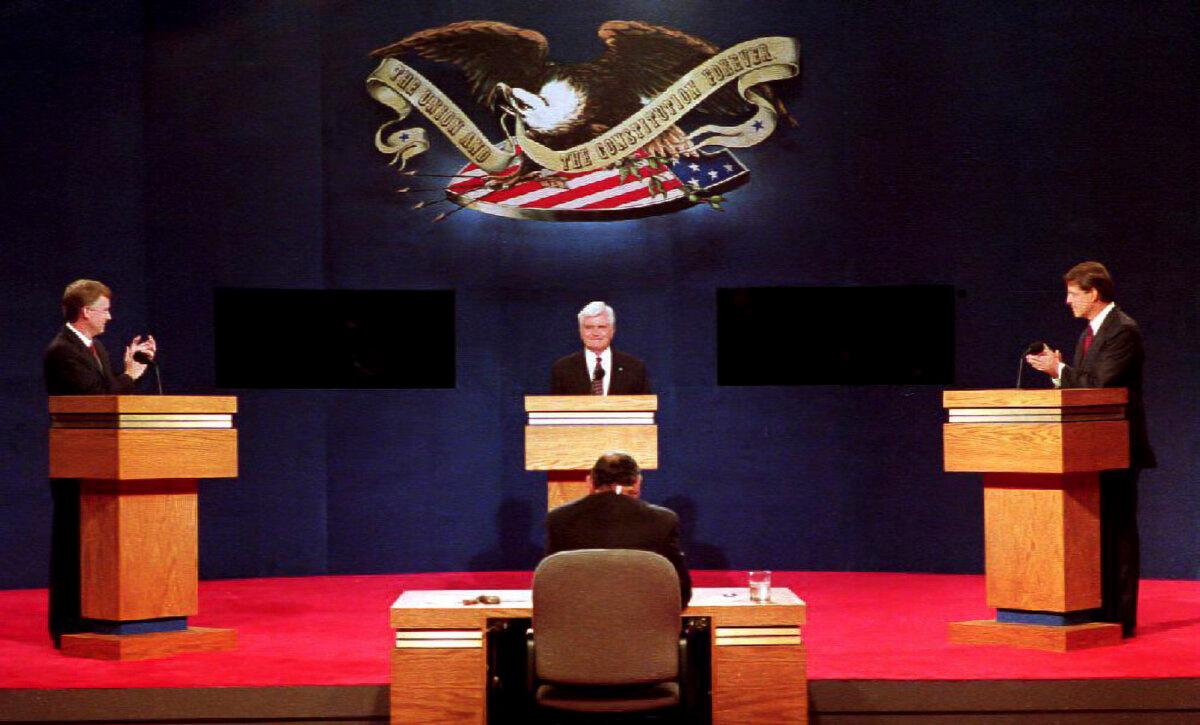
Though outside the political mainstream, the Reform Party in 1992 mounted the most successful third-party bid in 80 years.
Stockdale, the oldest of the three, began on a humorous note.
“Who am I? Why am I here?” Stockdale said, in response to the question many Americans likely had about the third-party candidate. The audience and moderators laughed at the remark recognizing the unusual nature of the Reform Party’s presence on the stage.
Bush had been facing increasing scrutiny from conservatives after he raised taxes, contravening his now-infamous 1988 promise: “Read my lips, no new taxes.”
Perot’s agenda, which featured many fiscally conservative planks, appealed to disaffected Bush voters.
The debate itself was chaotic, with Quayle and Gore firing accusations and denials, often speaking over each other. The moderator regularly had to intervene to give Stockdale a chance to speak.
“I think America is seeing, right now, the reason this nation is in gridlock,” Stockdale said to cheers and applause from the audience.
Perot siphoned off almost 19 percent of the popular vote that year, which is credited, in part, for Bill Clinton’s substantial electoral victory of 370 electoral votes to Bush’s 168.
2004: ‘Senator Gone’
The 2004 face-off—held between President George W. Bush’s running mate, Vice President Dick Cheney, and Sen. John Kerry’s (D-Mass.) running mate, Sen. John Edwards (D-N.C.)—was, on the surface, more subdued than previous debates.
There was no audience; the candidates sat at a table with a single moderator. But though neither raised their voices, the conversation—much of which centered on the Iraq War, arguably the largest issue of the 2004 election—did become heated.
Specifically, the debate focused on the U.S. invasion of Iraq after Sept. 11, 2001, terror attacks—a decision that left Americans sharply divided.
Cheney, who played an unusually active role in the foreign policy decisions of President George W. Bush’s administration, emphasized his foreign policy experience, defending the Iraq War.
Cheney presented Edwards as comparably young and inexperienced, criticizing Edwards for missing votes and committee meetings too often, and calling him “Senator Gone.”
“I’m up in the Senate most Tuesdays when they’re in session,” Cheney said. “The first time I ever met you was when you walked on the stage tonight.”
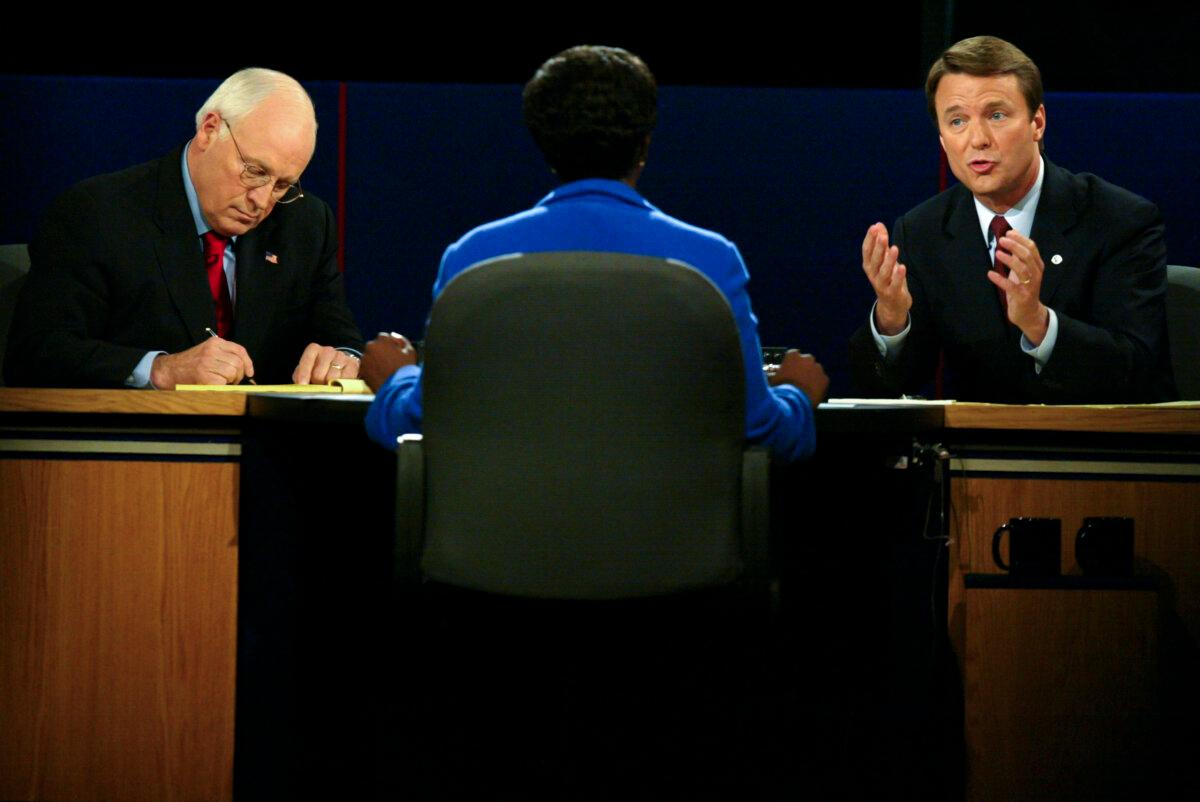
Edwards was critical of the direction of the Iraq War, capitalizing on one of the strongest issues for Democrats in that election.
Ultimately, however, Bush and Cheney were re-elected in 2004 by relatively slim margins, winning 286 electoral votes to the 251 garnered by Kerry and Edwards.
2008: ‘Say It Ain’t So, Joe!’
The 2008 debate—between Alaska Gov. Sarah Palin, Sen. John McCain’s (R-Ariz.) running mate, and Sen. Joe Biden (D-Del.), Sen. Barack Obama’s (D-Ill.) running mate—was most remarkable for Palin’s populist performance.
At the time, McCain was seen by some as too centrist to appeal to the party’s working class, conservative base. Palin’s placement on the ticket was interpreted by many as an effort to bring these voters back into the fold.
As she and Biden took the stage, the two shook hands, and microphones picked up Palin asking Biden, “May I call you Joe?” Biden replied that she could.
During the debate, Palin took on a working class tone, diverging from the type of political rhetoric most common up to that point.
She addressed Biden and the audience with folksy phrases like “You betcha!” and responded to an exchange with Biden with the phrase, “Say it ain’t so, Joe!”
The substance of the debate focused on issues like climate change, energy policy, economic issues related to the 2008 financial crisis, and same-sex marriage, which had become increasingly divisive.
Though Palin likely boosted Republicans’ performance among conservative voters, McCain and Palin ultimately lost to Obama and Biden, winning just 173 electoral votes to Democrats’ 365.


