




Patrick Jacksonand
Emma Brancatisano
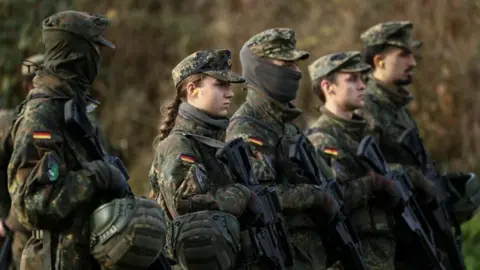 Reuters
Some of Europe’s biggest Nato members are moving to strengthen their professional armies through voluntary national service schemes.
Large conscripted armies were a feature of Nato states during the Cold War but they dwindled in size after the collapse of the Soviet Union.
However, Russia’s full-scale invasion of Ukraine in 2022 and the ongoing war there have kindled fears of a possible future Russian attack on Nato.
Here we look at how this new recruitment drive is playing out among Nato’s 30 European member states, many of whom still have conscript armies.
Who conscripts?
Conscription is in place for nine of Europe’s Nato states: Denmark, Estonia, Finland, Greece, Latvia, Lithuania, Norway, Sweden and Turkey.
In Turkey, which has the second largest military in the security alliance after the US, men between the ages of 20 and 41 are obliged to do military service for between six and 12 months.
By comparison, Norway conscripts both men and women, generally for 12 months.
Croatia plans to reintroduce conscription next year – it will become mandatory for men aged 19 to 29 to undergo two months of basic military training.
Other Nato members do not conscript but have professional militaries.
The UK, which rivals France or Germany in conventional military strength (and is the only Nato state in Europe along with France to have nuclear weapons), relies on a professional army.
It is unique among Nato members for recruiting minors – 16-year-olds may join with parental consent.
Albania, Czechia, Hungary, Italy, Luxembourg, Montenegro, North Macedonia, Portugal, Slovakia, Slovenia and Spain also have professional militaries.
Iceland has no regular military forces, though its Coast Guard performs some defence tasks.


Who is looking for volunteers?
Only this month, Belgium‘s defence ministry sent letters to 17-year-olds inviting them to volunteer for about €2,000 a month.
The voluntary military service scheme, due to start next year, aims to raise the number of reservists in the army from a pool of about 6,000 to 20,000.
Belgium’s neighbour, the Netherlands, launched voluntary military service in 2023 as it sought to underpin its professional armed forces.
Poland, which has one of Nato’s biggest armies, launched one-month voluntary basic military training in 2024. This year, Prime Minister Donald Tusk announced plans to introduce “large-scale military training for every adult male” in the country.
“We’re talking about the need to have an army of half a million in Poland, including the reservists,” he said.
In 2020, Bulgaria introduced voluntary military service for citizens up to the age of 40 for a period of six months and Romania plans to bring in four-month voluntary military service next year.
How does Germany plan to build ‘Europe’s strongest army’?
Germany ended compulsory military service in 2011.
Its parliament has now voted in favour of instating military service on a voluntary basis. If the security situation worsens or if too few volunteers came forward, a form of compulsory military service could be considered.
The new law will require all 18-year-old men to fill in a questionnaire asking if they are willing and able to join the armed forces, and from July 2027, undergo a medical examination to establish their suitability.
If war were to break out, the military would be able to draw on the questionnaires and medical exams for potential recruits.
Chancellor Friedrich Merz has said he wants to create the “strongest conventional army in Europe”.
The plan is to expand the armed forces from the current 183,000 active service personnel to 260,000 by 2035 – plus 200,000 reservists.
Students in about 90 cities across the country took part in a school strike on 5 December in protest against the move, with some using the slogan “Don’t end up as cannon fodder”.
A recent Forsa survey of German public opinion for Stern magazine suggested that while just over half of respondents favoured compulsory service, opposition rose to 63% among 18 to 29-year-olds.
What are French teenagers being offered?
France, which abolished military conscription 25 years ago, currently has around 200,000 military personnel and a further 47,000 reservists.
A new scheme envisages adding volunteers to the structure.
Young men and women will be invited to serve for 10 months of paid military training.
This new “national service” will be brought in gradually from next summer, mainly for 18 and 19-year-olds, who will receive at least €800 (£700) a month.
Initially, numbers will be restricted to 3,000 next year, but this should rise to 50,000 by 2035.
“The only way to avoid danger is to prepare for it,” President Emmanuel Macron said while announcing the plan. “We need to mobilise, mobilising the nation to defend itself, to be ready and remain respected.”
Polls suggest a large majority of the public favour voluntary military service. An Elabe survey found that 73% supported the measure. Young people – aged 25-34 – were the least supportive, but even in this age group there was a 60% majority.
What about the rest of Europe?
Europe’s other states take various approaches to staffing their militaries.
Among EU states not belonging to Nato:
- Austria has a system of compulsory military service for men aged between 18 and 35, who are required to serve for around six months or take part in alternative service. Women can serve voluntarily
- Cyprus has compulsory military service for all male citizens over 18, along with some of those who are of Cypriot descent. Women can enlist voluntarily after a law passed parliament in April
- Both the Republic of Ireland and Malta have professional militaries
In Switzerland, a non-EU country, male citizens aged 18 to 30 must serve in the military, or join civil defence or an alternate civilian service.
Last week, Swiss voters widely rejected a proposal to extend national service – in the military, civil protection teams or other forms – to women.


